Unknown's avatar

Why can’t this be love?

My three year old has recently started saying, every so often, “I love you Daddy,” in response to my saying “I love you Connar.” It’s pretty cool when he does it. For a while, he would just say, “Ok.” I prefer “I love you” a bit more. It’s a bit more personal.
For a little while I even thought about instructing him. Connar, when someone says, “I love you,” you say, “I love you too” back to them. But then again, I thought that was quintessence of in-authenticity. I wanted my son to say, “I love you” back to me, but I wasn’t about to force him, or even teach him that’s what you’re supposed to say. I realized that in time, whether by social convention or true love, he’d say, “I love you” back to me. Why force him when he’d eventually come around?
That kind of thinking makes sense for a growing boy. He’ll get it eventually. Yet for many who have problems with predestination and God’s sovereign call over someone, this parental conundrum seems to trump sound exegesis. On the surface we may think, “Do I want a Father who makes me love Him?” Is that really loving on his behalf? Is that really love at all? Shouldn’t God just wait for us to say, “I love you too?”
The problem is that all of us are spiritually still born (Ephesians 2:1-5). We’re not growing boys and girls who eventually hear God saying, “I love you,” and then respond in time. We’re dead in sin and incapable of a response. It is in this context that we are “made alive.” We can’t love Him without His first making us alive. So it’s not out of arrogance or an overbearing Father that is impatient and needs affirmation from His children. He sees people who can’t say I love you. He sees people who can only say, “I love myself.” And He has compassion on such people. In fact is “because of His great love” that we are made alive.
Once we have been made alive, and are freely chosen, we freely choose-we want to. They now can, for the first time, hear “I love you” from their Heavenly Father.  That’s what theologians call “irresistible grace.” Of course we choose. But we’ve first been chosen. And when we hear our Father’s voice for the first time say, “I love you,” can we choose anyone or anything else? No of course not. No one else will do or suffice.

That is still love to me. In fact, as Van Halen once sang, “It’s got what it takes, so tell me why can’t this be love?”

Unknown's avatar

On Gisele, motivations, and the church

This is a great example of praying for something and then not getting it.

Tom Brady’s wife Gisele Bundchen, who may be getting the gag order next time that joker plays in a big game, urged people to pray for her husband Tom to win the Super Bowl.

Unless you’ve been in a cave the last day or so, you probably know that the Pats in fact did not win the Super Bowl. As a result she did what any “normal” high profile Q.B.’s wife who had asked for national prayer via twitter would do: blast the F%#@ing receivers for not catching the balls thrown to them. An ESPN article says:

After her prayers for a Patriots’ championship went unanswered, Bunchen lashed out at the team’s receiving corps for failing to haul in her husband’s passes. While waiting for an elevator at Lucas Oil Stadium, Bundchen was being heckled by Giants fans when she spoke to people in her group.
“My husband can not f—— throw the ball and catch the ball at the same time. I can’t believe they dropped the ball so many times,” Bundchen said in a video captured by theinsider.com, a gossip website.

The title of one article read “Gisele Bundchen (Mrs. Tom Brady) goes from asking for prayers to dropping the F-bomb in 24 hours!” Most people found this a little ironic, if not hypocritical. I did too.

Here are a few questions and takes:

1.) What God is she praying to? Probably not Allah, but was it the Judea-Christian God? Was it the impersonal force that we all know and love called Karma? Since she didn’t just want “positive thoughts (I love that one, whatever thoughts can do….)” but actual prayers, I’m a bit curious who I was supposed to pray to. And if I did run into Gisele, I’d have to be straight up with her and tell her I did actually forget to pray. That’s what happens when you don’t write prayer requests down….I’ll be ready for it next year.

2.) What to do with unanswered prayers? We often don’t get a “That’s why I didn’t answer the prayer the way you wanted me to” from God. But He does give us a little bit of insider information in James 4:3: “You ask and do not receive, because you ask wrongly, to spend it on your passions.” Sometimes our motivation for specific things like a bigger house or better spouse can reveal an underlying selfish motive. God wants us to change even if our house doesn’t get bigger or our spouse better.  What is often overlooked is that our behaviors and responses to things like “unanswered” (they were answered, just with a “no”) prayers and desires often reveal the selfish motivations behind the requests. You can examine your heart till the cows come home, but often the only way to truly know the heart attitude is by how we respond when God tells us no.

We just had the blessing of a new building. He said yes. And so we thanked Him and will thank Him more formally in a few weeks with a thanksgiving service. However, how we responded when God said “no” along the way was in fact a greater indicator of our heart’s true allegiance.

3) Gisele, like it or not, reminds us of the Church. How many stupid things have Christians said or done that has made her bridegroom look bad? We say and do just as many dumb things as Gisele, and we (I’m assuming I don’t have any supermodel followers) aren’t even models, much less supermodels. Yet Jesus still loves His bride. I’m very curious how Tom Brady is handling this situation with his own wife. Hopefully behind closed doors and not via the media, social media, or internet, as is often the case with high profile pastors and other Christians.

Unknown's avatar

A thinking message or an altar call?

Last week I had the opportunity to speak at the chapel of a local Christian school. I spoke on one of my favorite passages, Mark 9, explaining that Jesus can do something with our unbelief when we bring it to him. Before the chapel started, the bloke in charge asked me if there would be an “altar call” or if I was planning on “leaving them something to think about?” An altar call or a thinking message…
Who knew those were my two options?
Instead of explaining my take on altar calls, I politely (maybe I’ll get asked back) said, “It will be a ‘thinking message.'”
I won’t go into my thoughts on the 19th century invention of the altar call, as I’ve already done so here. But I do want to explore the question this man asked.
Should a sermon or a talk leave people with something to think about or should it call them to action? I think the answer is probably a qualified “yes.”
1.) Thinking. Of course, leave it to a Presbyterian to affirm the thinking part of a sermon…But people do need to understand what the passage in context really says, what it means, and why believing that passage makes a practical difference in life. Ideally, I want folks leaving a sermon thinking more and more about the passage, how it points us to the gospel, and how our lives will change because we’ve personally embraced that truth. You never want a, “Well now I know all there is to know about that passage and how it relates to Jesus and how I’ve already changed….” If the roots keep getting deeper, the fruit will become that much more evident.
2.) Response. One of my favorite pastors, and former professor Steve Brown, always (I think he still does) concludes his sermons with “you think about that.” He doesn’t mean for you to simply think, but to respond to the gospel. A good sermon always calls for some response. Now perhaps that response is one that no one sees. Perhaps it is a call to awe and wonder at the majesty of God. That is still a legitimate response, and one that is quite necessary when preachers like myself can emphasize God’s immanence at the expense of His transcendence. Now I can call people to come down an aisle and commit to being more in awe of God, or I can preach about His faithful character and say something like, “Now doesn’t this move us to awe?” I choose the latter.
Our sermon passage yesterday was on Psalm 92, which is a thanksgiving psalm. The main application Barret left us with was to make sure we focus on the giver more than the gift. No one may necessarily see that, but if by faith we respond, folks will eventually see a difference. They will never see us become angry if the building isn’t being used exactly as we want it. 
Sometimes the response to a sermon may appear more active. It may mean that after you understand the “why,” you feel the need to respond by seeking forgiveness from someone you have wronged. It might mean that you spend time with your spouse next Friday night. It might mean that as a result of believing the gospel, you consider tithing, or supporting a missionary. It could mean that you become part of a church plant or stay at your existing church.  Both are active responses. You don’t need to “come on down” in order to respond. 
But neither should you simply think about what’s been said and conclude with, “That was a good sermon. I liked it.” 

A good sermon challenges the head, the heart, and the hands. However, the preacher may emphasize a response aimed at one of these areas more than the other.

Unknown's avatar

On critiquing and being critqued

A blogger I follow, some Canadian I’ve never met but have been very impressed with his gracious writing, Darryl Dash reiterates some of Tim Keller’s address to some UK churches. His post is here.
  • To respond [to critiques], evangelicals must understand and practice biblical repentance as a result of believing the gospel. This will allow evangelicals to admit their sins, even if they disagree with 80% of the criticisms … and even if the remaining 20% is expressed poorly. To the degree that we understand the gospel, we will be able to freely admit our shortcomings as an evangelical movement.

  • To the degree that we understand the gospel, we are free to admit the worst about ourselves finally. Repentance isn’t how we get right with God; it’s just the right response. It gives immediate assurance.

  • Don’t ever think that we can respond to legitimate criticisms of our practice by defending our doctrine. In defending our doctrines, we have not responded to the criticisms of our practices. Orthopraxy is part of orthodoxy.

  • It is necessary to draw boundaries. What really matters is how we treat the people on the other side of those boundaries. People are watching. We’re going to win the younger leaders if we are the most gracious, kind, and the least self-righteous in controversy. The truth will ultimately lose if we hold the right doctrines, but do so with nasty attitudes and a lack of love.

  • We need to approach the controversies with a repentant heart corporately and say, “Despite all the bad things that are being said here, there’s a core of truth here and we need to deal with it.”
 Then finally he concludes with this priceless snippet
My dear friends, most churches make the mistake of selecting as leaders the confident, the competent, and the successful. But what you most need in a leader is someone who has been broken by the knowledge of his or her sin, and even greater knowledge of Jesus’ costly grace. The number one leaders in every church ought to be the people who repent the most fully without excuses, because you don’t need any now; the most easily without bitterness; the most publicly and the most joyfully. They know their standing isn’t based on their performance.

I tried to add some of my own thoughts, but I just couldn’t improve on what had already been written. Great stuff here, applicable for those in any area of leadership: pastor, elder, deacon, parent, teacher

Unknown's avatar

Why have small groups in the homes?

Several people have asked me, “Since we have a new building, will we move our CD groups into it?” My answer is an unequivocal “no.” Let me explain. First of all, there is no command in scripture on where to have a CD/community/fellowship group or bible study. So they could gather in the new church building, and there may be some which eventually take place in the church. But here’s why I think its best to have CD groups in homes.
1.) Homey. There is a much more, well, “homey” feel to a home. That’s obviously impossible to argue. People tend to feel more comfortable in homes. You can get to know someone at church for a bit, but there is a difference when you get to know someone in a home. It just goes deeper. To me its the difference between knowing someone at work and doing something with that co-worker outside of work. It’s just a different environment and that makes for a more personal relationship. I was also asked once,”We’ll keep the groups in the homes when we get the building, right?” Those who meet in homes usually don’t want to stop. Even one youth was sad to hear that we wouldn’t keep having youth group in homes. I assured her that we would have youth group in the youth house. I guess that sufficed….But it just showed me that even some youth like that “homey” feel.
2.) Where do pastors want folks to live out their faith? We want people to live out their faith where they work, play, live. Everyone’s home should be a place of discipleship. Parents are the primary instructors of their children. Parents read their bibles in their homes. Most of life happens outside the church building, and that is good. So this is but another opportunity to apply the gospel IN a place where life happens. What better way to expound and apply the gospel truth than by literally bringing fellowship, prayer, study of God’s Word INTO the home?
3.) Mature disciple. The mature disciple is not someone who spends 7 nights a week at the church building. That is not maturity-that is a flight from loving your family, neighbors, non-believers. The benefit of not having a church building is that people can’t be “at church” 24/7.  As a result, it is sometimes necessary to make sure folks aren’t at the church building 24/7. A mature disciple cares for his/her family, cares for his/her neighbors, shows mercy, reaches out to lost, and makes other disciples, etc…These things just simply can’t be done if one is at the church building all the time  (though I’m incredibly thankful for those who’ve spent almost whole days here getting the building ready for worship!). Having CD groups in church building doesn’t mean this will happen, but simply can open the door for that mentality.
4.) Invitation A home makes it easier to invite people, particularly those who may be hesitant to come to your church. 
5.) Limitation. Having a group study in your home limits the size. CD groups really operate best when they have 8-14 people. When they get too big, it’s best to multiply them. A large building offers the opportunity for a large crowd. But again, having 25 in a bible study is not the same as a well functioning small group that can seriously share prayer requests, give ALL people a chance to answer and participate in discussion. Many folks clam up when the number gets too big.

These are just some reasons why I think its best to have CD groups in homes as opposed to a church building. Some large bible study groups, lectures, seminars, training times might best occur in the church building. But I think the home is the best (I don’t say only) place, in general, for a small group to thrive and eventually multiply.

Unknown's avatar

Figuring out what to study next

When I was in high school, I didn’t have many choices on what classes to take. I liked it. When in college, I had some more flexibility, but much of the guess work was taken out:  take 3 classes, 2 classes, and then 3 classes each tri-mester and I would graduate. 
When it comes to teaching or leading a small group, choosing what to teach next can be difficult. Here are some guidelines that help me think through what to teach next. They are not from Mt. Sinai, nor are they ordered in any sense of primacy. But cumulatively they can be helpful to make sure that you are teaching on a variety of different, relative subjects, moving those under your care towards maturity in Christ (Col 1:28-29).
Some churches have designated key areas, and leaders can choose a book from each key subject area. One of my churches I served at had 10 separate keys that would take place over 3 years. Then you repeat. This method is thoughtful and ensures that you cover a variety of issues-some of which you or your group wouldn’t choose but nevertheless needs to discuss. While this plan makes sense, I don’t know if it is absolutely necessary. That church tried this method, but not for long. Systematically going through topics is grand, but I just don’t think you can cross subject matters off the list and then move on. That’s why I prefer something a little more flexible.
1.) Bible. In college, I remember a bible study that I went to once. They challenged everyone to take seriously, very seriously, what we would be studying for the next semester. Like we could end up studying the wrong bible book. I thought, well, if its the bible, that’s probably good. They didn’t think that, but I still do. I’ve never studied through a book of the bible and as a group discerned, “This really wasn’t relevant. I think we should have studied a Pauline epistle instead of James….” Never. The Good Book Company and Matthias Media has all kinds of great bible study guides.
2.) Have a frame-work. While I don’t think you necessarily need to be locked down into a systematic grid for what to study over the period of 5 years, I still like having a framework. We should have in mind issues and topics to consider for our next study or discussion. If you don’t have any framework in mind, you may tend to skip over some issues you could have ignored. The framework I think through is the Head-Heart-Hands Model. Is there anything that our group would benefit from knowing more about God (Head)? Maybe we need to spend some time on Christology because people don’t understand who Jesus really is (Head)? Are there any Heart issues, like materialism, worship of family, which could be best tackled through a specific book or study? Is it best to continue to lay a gospel foundation, which people may not really grasp (Heart)? Are there any practical (Hands) issues like how to parent, do finances, how to study bible, how to share your faith, how to show mercy, etc…? I tend to reserve the latter two for small group and the former for Christian Ed/Sunday School. If you tend to study practical issues in books, then its probably wise to take a break and simply study the bible, books, or studies particularly plumbing the depths of the gospel. If you’ve never gone theologically deep (Head), but focus primarily on the practical and outreach/mercy (Hands), then it might be wise to balance. A framework can help that.
3.) Freedom: Those who oversee certain ministries have the final say on what gets studied. That’s their “job.” I prefer to give leaders lots of freedom because they are at ground level, hearing what is being discussed. They hear the answers. They know if the group lacks knowledge (Head), the application of the gospel to life (Heart), or if the group knows anything about tithing, showing mercy, reaching out, whether they are serving their church. So as a leader, you just want to have these things in mind. You are a student of your group, as much as they are a student of your teaching, leading, shepherding. 
If you are attentive, you will begin to discern heart issues, growth areas, application blind spots, areas of scripture (all of the aforementioned you may have too!) that you’ll want to keep in mind for the next, as well as the current study material.
Some questions that can helpful to think through are as follows:
a.) What keeps them up at night? What scares them? In other words, what are their idols? Respect, work, love from spouse/family/friends, family? Anything that if taken away, would leave them with no reason to get out of bed.
b.) How well do they know simple truths of the gospel? Are they ready to move deeper (not advance beyond)?
c.) Does any theological question keep coming up? Is there any section of the bible which they seem to deficient or interested in knowing more?
d.) Are they interpreting and applying the bible in a Christ-centered way or simply as instruction manual?
Some things may be more pertinent or pressing to study than others, so that’s why I like to get input from leaders.
4.) Asking: Much of the time you can get what you need to study by thinking ahead of time where you want the group to go, and then tweaking that plan if need be, by your attentiveness to their needs. However, another way to supplement (not replace) is by asking them. It can be helpful to ask if there any issues or sections of the bible which you feel you need to study? This can sometimes be quite helpful. Or you can ask something like this, “Would you be interested in studying a book by so and so?” I did this and it let me know NOT to go through a particular book because they wouldn’t have time to read it. I’m glad I asked and I appreciated their honesty!
However, you also need to be aware that sometimes people will pick something that he/she wants to study but the individual, or the group as a whole might need to study something else. For instance, someone might want to study “end times” or “prophesy” when in reality, he/she doesn’t know his spiritual gifts, or is shacking up with his girlfriend or boyfriend.
5.) Sermon discussion/application: I’ve never done this in a small group bible study, but many churches do. My last church did this off and on in Sunday School, which took place after worship. Many enjoyed and benefited from it. The Mars Hill churches have this as a regular component of their community groups as do a number of other larger churches as well as thriving church plants. The idea here is to focus not primarily on what has been said, but to believe the truth that has been preached, and apply what has been preached. This of course requires that your group is regular in worship and the leader takes notes and asks good application questions.

The most important thing you do as a CD/Small/Community group leader is to shepherd the people in your group. Picking material is part of that shepherding process, but it is only part. Praying for, teaching, following up with, loving on, and pointing them toward Jesus are the bigger parts. Be faithful in those, and then pick the material that you feel is the best (of course have it approved!), and you can’t go wrong.

Unknown's avatar

On Kyle Williams and Manning-up/Womanning Up

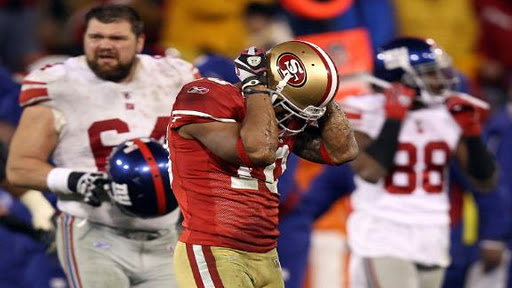
There were some great football games this past weekend for the divisional championship round games (winner goes to Super Bowl). Unfortunately for both losing teams, their losses are mired in the mystery and misery of mistake ridden final moments.
The 49ers lost to the giants in OT because kick-returner Kyle Williams fumbled the ball on his team’s side of the field. As a result, the Giants kicked the game winning field goal. Unfortunately for him, he actually received death threats via twitter (unfortunately its not just soccer where that happens).
The Baltimore Ravens lost to the Patriots due to a missed field goal in the final moments which would have sent the game into OT. 
Two games. Two goats. 
But each responded a little differently. 49ers Kick Returner Kyle Williams owned his own mistake. Ravens kicker seemed to do just that. But then he began blaming the New England scoreboard for not putting the correct down causing him and his teammates to rush. Given New England’s penchant for cheating, I’m sure that it was intentional.
However, two games, two goats. Two different responses. As Jim Rome said on his radio show today, “One guy manned up, and owned it. That’s macho.”
I’m always interested in what folks consider masculine, or in other words, what “real men do,” because even “Christian” masculinity seems to be cut and pasted from respected cultural norms. Then you can just throw a verse or two on top of it and canonize it.
But because man is made in the image of God, we shouldn’t expect everything held high in our culture to be completely devoid of biblical truth. Rome is on to something here. In part.
Right: It is “manly” to confess when you screw up. Men often run from their problems. We blame. Adam did it. But redeemed manhood does confess. And this can be hard because men are designed to lead and saying you screwed up seems to get in the way of leading. But part of leadership is being able to say, “I screwed up. I own it. It’s not YOUR fault. It’s mine.” People like that. Kyle Williams’ teammates did too. Of course this really can only be accomplished by a deep belief in the gospel that says, “I screwed up, but God loves me the same as He did before I screwed up. I don’t lose my opportunity to lead, but have the opportunity to recognize my need for grace. Ideally others will also see their need for grace too.”
Perhaps not as Right: While it is “manly” to confess when you screwed up, I don’t know that is is uniquely manly. Men do need to take the lead in this because, well, they are to lead. So maybe there is a primacy…Yet you could also just as truthfully deem this quality “womanly,” or feminine. You could just as easily say, “Woman up, own this, and move forward.” Adam blamed Eve. Then Eve followed his example and blamed the serpent. Just like the natural man, the natural woman, is prone to blame shift. But the redeemed woman, can also believe the gospel, and “woman-up,”  and display this “manly” or “womanly” quality.
Owning your mistakes and shortcomings is both masculine and feminine, if you have to put it in those terms. But truthfully it is simply living out the gospel. It is Christ-centered more than anything. 
The fact that some people appreciate this characteristic is but another example of the ways man/woman still images God. While I don’t know that this is SPECIFICALLY masculine, it is still part of godly masculinity. And it’s great to see this quality praised as opposed to what passes as “macho” in beer commercials. Maybe folks like Jim Rome will take the next step and say, “I screwed up because that’s what I do. I’m a screw-up. But Jesus loves screw-ups who recognize their need of His grace.”

Unknown's avatar

Reflections on Winter Jam

Several weeks ago, because I thought that we needed more adults, I attended the Winter Jam concert  in Charleston with the Redeemer youth. We had a great time hearing from a variety of different Christian bands-some of which I had actually seen in high school and college. So that part was a stroll down memory lane for me. I had a blast with those and really enjoyed the craziness of the hard rock band Skillet.
Let me give you my synopsis of the highs and lows of the concert…
Highs:
High parent to student ratio. Really high. That is a good thing. Kids need adults in their lives. Lots of them.
The place was absolutely packed. It was encouraging to see the number of folks in WV (and some from farther away) who came out to hear bands that they most likely listen to during the week. Because most youth haven’t developed a very strong filter yet, I”m glad that they are listening to Christian music.
In addition, I was encouraged by bands trying to reach kids I can’t, and give them something to listen to that is different that what they are normally offered. I was also encouraged how deft they were at contextualizing the Christian faith into the world of these students. You don’t have to wear skinny jeans and be hip to be a Christian. However, you can be. I’ll not be wearing skinny jeans. Ever. But when youth see clean cut, khaki pants/jeans wearing pastors and parents, we need to make sure that they don’t have to look like us either. 
The bands honored Jesus. The last band, a hard rock band called Skillet, talked a good bit about Jesus. Now when they sang, I couldn’t really tell what they were singing. But when the lead singer talked, he did talk about Jesus. That was refreshing.
Lows:
While I appreciated that there was a gospel presentation, and I appreciated that there was a call to repentance and faith, I didn’t so much subscribe to the methodology of having everyone say the magic “sinner’s prayer.” We were ALL instructed to close our eyes and say after him the magic prayer-no matter how many times we’d already said it (and he even hinted that he’d “come forward” a few times, though those trips didn’t mean anything-which should tell us something!). Then by virtue of everyone saying that prayer, we should expect a few conversions or re-dedications or something. Kind of weird. Weird but consistent with evangelicalism.
There really isn’t a magic sinners prayer that you can say, where you are “spiritually tasered,” and then transferred from the kingdom of darkness to the kingdom of light (Col 1:12-13).
One band talked about having “church” together without actually going to church. I can understand that it may be hard to attend worship regularly when you are hitting up so many cities in so short a time. And if you can’t gather together with an assembly of believers, then getting together is the next best thing. But it is not “having church.” Hanging out with your buddies and the bible is not really the picture of church we see in the bible. 
Many Christians don’t have a very good picture of the church and so think they can just as equally worship God by going surfing, sleeping, skiing, or doing family time. Sometimes these venues (though I don’t think this one did) can become “church” for that week. It takes an effort to express that while this concert IS good, it is NOT a good replacement for regular corporate worship. I’m very thankful for bands like Casting Crowns that clearly stated this when I saw them.
Finally, it was a bit weird-though not inherently wrong-to take up an offering. They “passed the hat” around and people were asked give to this ministry. Since the concert was only 10 dollars, it didn’t covered all of the production costs, of which Skillet’s pyro-technicians had to have received 95%.
I would have more happily paid 15 dollars and not seen the hat. Again, just a bit different and weird-not wrong. I think more people are reached by church planting then concerts, so that’s who’s next in line for my money.

All in all, a good experience though and am glad I went. While I don’t listen to contemporary Christian music, live music is tough to beat.

Unknown's avatar

A Dolphin Tale: Should we save Dolphins? part II

This is a continuation of a post on my previous post on why or why should we not take the time to save wounded dolphins.

1.) We are called to have dominion over creation. This doesn’t mean that we rule over it in the sense of ruthlessly destroying creation the way much of humanity has done when they decimate fish and animal stocks. Instead we are to cultivate the creation, and included in that creation, are God’s creatures. I remember when my buddy threw a rock at a crab after I prompted him to do so when on foreign study in Israel (at En Gedi-where David hid from Saul). Someone came up afterwards and said to him, “S$#$% you and your dominion-over-creation thinking.” That really isn’t true dominion type thinking. Neither he nor I were actually acting consistently with our belief and worldview.

2.) From a Darwinistic worldview, it does not make sense to me why you should help sick animals. Even cute ones like baby dolphins. The healthy ones are supposed to survive and produce stronger offspring. Helping sick animals only stops that process that made the dolphins what they are. Yet I would imagine many of these marine biologists are complete Darwinists, so to me, that seems a bit on the irrational side. Again, this is just how I see it from that worldview, but would welcome thoughts from someone who fully lives according to that worldview.

3.) God does seem to genuinely care about animals, aside from the general verses which speak of him providing food for ravens (Luke 12:24). In the book of Jonah, God “reasons” with Job and rhetorically asks him, “Should I not pity Nineveh, that great city, in which there more than 120,000 persons who do not know their right hand from their left, and also much cattle?” Should I destroy the animals too? It is possible that we learn something of God’s concern for animals-though I wouldn’t build a theology around it!

4.) Difference between man/animals. I’m actually not a big dolphin fan because they have eaten way too many snook and redfish in front of me and ruined some quality fishing opportunities. But I do appreciate them and enjoy pointing them out to folks who have not grown up with them in the way that I have. There is a creator-creature distinction between us and God. Yet creation is further divided between man/woman, and under us are creatures (Psalm 8). People are more important than animals.  Many people don’t believe this, and that is consistent with a Darwinist worldview.

But the Christian worldview does not allow such equality. Sometimes our love of animals (and I do love them) can literally cross the line where animals are elevated above people. Love your dolphins, cats, and dogs, but be very careful that a good thing can become a bad thing when it replaces the ultimate command-loving God and loving other PEOPLE. If you love your pets more than you love your neighbors, then you are not having dominion over creation; in fact the reverse has become true.

Unknown's avatar

Winning and Losing: God’s help and God’s involvement

This Sunday I preached on Philippians 4:10-23 which includes the famous or in-famous Phil 4:13 “I can do all things through him who gives me strength.” The major theme of this passage is thankfulness, but the “sandwiched” truth in the middle is that we CAN be content in all situations: from bad houses to bad spouses, from losing to bad weather. Now I’m not saying I always believe that; I often don’t. But I think its more scriptural to say I CAN THROUGH CHRIST honor God and find contentment in specific situations than it is to say “I just can’t….” (which we all say from time to time, right?) and become angry, gripe, or run. The sermon can be found here.
I pulled for Tebow and the Broncos vs. the Patriots (I pull for anyone vs. the Patriots) but pretty much saw on the TV Saturday what I thought I might see: a clubbing.

But I’m very thankful for how far the Broncos went this season and the opportunities for Jesus to be talked about by secular sports talk show hosts that probably don’t even know or usually care too much for Him. Because of Tebow, pastors and theologians have also been given a platform as well. One such article, that I think is incredibly apropos for all sports fans, is the Atlantic Journal’s  “Does God care if Tim Tebow wins on Saturday.” How cool is it that The Atlantic Journal, read by all kinds of different folks from all kinds of different beliefs, has given those folks a chance to read about God’s Sovereignty, Providence, Secondary Causes, Calvin, etc…, and of course Jesus. Check it out, as it will be helpful not just as an athlete, fan, or parent, but simply as a person navigating this world with the hope of a Transcendent as well as Immanent Lord.

Whether winning or losing, we see a growing Christ-centered contentment in Tebow (as opposed to his crying after loss at FL), as well as the opportunities God has afforded many others through his faith, passion, service, and play on the field.