Unknown's avatar

Teeball, children’s ministry, and the next level

My 5 year-old son Connar is good at pretty much anything with a ball. He is especially good at baseball, or I guess I should  say, Teeball, aka “ruleless” baseball. He’s always been hands down the best player on the team, having never needed the Tee (they pitched to the kids in W.V.). But this year, after having to play his 2nd season on the Tee, there is nothing “hands-down” about his hitting. In the fielding department, no one can throw and catch as well as he can-though the coach’s kid is almost there. But in regards to hitting off the Tee, several other kids have actually hit better than him this year.

At first I thought we should probably practice on the tee at home. But then I thought “why?” Why even seek to make him excel and be the best “Tee-ball hitter” on the team. Is that really my goal? Obviously I want him to have fun too.

Nope, my goal is to get him ready for “kid-pitch.” After Teeball, comes the 40 mph machine pitch. And then then comes “kid-pitch” where kids throw it all over the place. We practice most every day by me throwing him fastballs inside, mixed with outside pitches, and even sidearm pitches too. My goal is not to make him the best Teeball player, but to get him ready for the next level of competition. That’s why we don’t work on the tee at home.

I think this is an important aspect of children’s and youth ministry. Our goal shouldn’t be to have the best Teeball player out there on the field, yet that is what I think many of us, at times, seek in children’s ministry. Instead of having the best behaved, most “programmed” kids out there, we ought to think about getting kids ready to play at the next level: when they leave the house.

The whole “what do you have for my kid to do” approach isn’t churning out “ball players” at the next level. It really isn’t. Kids become teenagers and then college students, and many leave and don’t come back. But many people simply refuse to evaluate and question that perhaps our goals are short-sighted. What do you call someone who does the same thing over time with same results?

I’m not saying to ditch programs. I’m just saying evidence (and the bible too) is showing us why we can’t rely upon them, or even make them the sole reason why you attend a certain church. While there is no magic solution to make sure kids are ready for the next level, there are some adjustments and changes we can all make.

1.) Parents: Mom and Dad have primary responsibility to teach their kids about Jesus. There are plethora of resources that help in this, and it honestly doesn’t take a lot of time. The New City Catechism doesn’t take long and comes with cool songs that the kids and I can dance to. Yes, the dancing is not pretty, but it gets the job done.  Plus how much of teaching is simply taking the time to sit down and discuss what’s going on life?

2.) Plugging kids into service of church. I have an 18 year old who told me he would love to train a particular 9th grader on how to do work with sound stuff. How cool is that? This kid gets it. He hasn’t been a spectator but one who has served over the years. My 5  year old wants to hand out bulletins. I saw a 6 year old stacking chairs this Sunday with our church plant. Kids who see the church as a place to serve instead of only as a place to receive, seem to be do better at the next level. Kids have gifts, so lets not wait to use them.

3.) Multiple Adult relationships. This is huge. The other day my 5 year old said, “We need to pray for Mr. so and so who is at the mission conference this weekend.” I forgot. He did that because this adult has shown an interest by simply talking with my son. I can’t wait to see what other adult relationships he develops over time. I’m not putting my hope in one rock star youth leader but hope for him to have several other guys he can look up to outside of the home. I relish that help.

4.) Children’s/Youth Ministry that thinks about the next level. At my last church, the nursery had a goal of getting kids ready to sit in church. The children’s church (4-1st grade) had as a goal to get the kids ready to sit through a sermon. Our youth Sunday School and youth group had specific rotating teaching goals to prepare them for the next level. At Harbor Community’s children church, we have as a goal to both teach them at an age appropriate level, and to prepare them for 4th grade when they’ll be “blessed” to listen to me for 30 minutes! Our goal is to get 5-6 teams of two, and over the years, see relationships with adults develop with these children.

5.) Distinguish gospel from morality. In our children’s church (4-3rd grade), we use The Gospel Story Book Curriculum. It helps teach the kids the redemptive story of the bible as opposed to seeing the separate stories as stand-alone stories without their place in the overall story of the bible. But in general, if kids can begin to grasp the uniqueness of the gospel, they’ll be able to at the very least know the difference between a church and club (or church’s that have become clubs). How is the gospel different than “be good” or “give peace a chance?” Kids have to know the difference.

There’s no magic formula. And I think you can ask too much from kids as well. I’m not trying to get my 3 year old ready for “kid’s pitch.” I want to get him ready for Teeball. That’s the next level for him.

Regardless of results (and many have documented a number of these common denominators in kids who walk with Jesus and His church after leaving the home), we’ll honor Jesus by conforming our efforts with His Word.

Unknown's avatar

The only pressure-free way to live is to glorify God

If you’re at all like me, or rather, if you’re a human being (and if you’re reading this, those are good odds), you feel the pressure to perform. Now it could be in your job, as a parent, or even in your hobby. Especially if you’re competitive and feel “all of life is competition.” I often do. Whether it be me, or my kid competing in sports, there is a drive which goes beyond a healthy sense of the satisfaction with getting the job done to a very obvious idolatry.

Or perhaps even more subtle is the drive to religiously perform and look good before God and others. Church related performance can sometimes feel even tougher at times. But it shouldn’t.

Harbor Community Church’s mission/vision statement is “To Glorify God by multiplying a gospel-centered, city-blessing, missional and maturing community in West Bradenton.”

I’ve trimmed and tweaked this statement over time to make it easier for myself and others to know, memorize, and share. I was very close to taking out the “glorify God,” simply to make it simpler. But I’m glad I didn’t. Here’s why.

Whether we eat or drink, we are instructed to do all for the glory of God (I Cor 10:31). Including plant a church. Now I know the words “glorify God” don’t need to be in a mission/vision statement for a church to glorify God. That’s why I considered cutting it. But the busier I get into this church planting thing, the more I’m tempted to forget that vital truth.

In John 1, John the Baptist is described as not being a light, but instead coming “to bear witness about the light.” He simply pointed people to Jesus. It wasn’t about his glory and fame but about God’s glory and fame.

One of the side-effects of “taking pains” to remind ourselves about glorifying God corporately as a church is that as individuals we can relax. Because God can be glorified in whatever outcome, that immediately removes the pressure of a perceived picture of success. In a job, you work hard, but you can relax because you know that God can be glorified most not by your success or failure, but by you finding your pleasure/enjoyment in Him (Westminster Shorter Catechism Q 1).

Amy and I have started watching Friday Night Lights on Netflix. A college scout came to watch the start running back and potentially recruit him. The running back’s goal in life was to go to college and play in the NFL. As a result of such pressure, he stunk it up, and then turned to steroids to get bigger. The pressure to glorify oneself is too heavy for anyone to carry. So we turn to other stuff like drugs, or simply needing unhealthy affirmation from anyone or everyone in order to feel good about ourselves.

The reality is that living to glorify God is the most pressure-free way to live. It’s the most pressure-free way to build and multiply a church. That is not to say it doesn’t involve massive volunteer force, particularly in the area of children’s ministry, setting up, reaching out, etc….But when you do those things with the attitude that your ultimate aim is to glorify God, you become willing to learn, step out, serve, love. You become willing to fail if that would glorify God. Your goal isn’t to glorify yourself or even the church, but God.

Pressure is off.

The pressure can become overwhelming in glorifying yourself.  If you’re not able to both work hard and yet relax at the same time, then you’re probably still trying in some ways to glorify yourself. I was convicted of that this morning. Our first order of business will always be to bring fame, honor, and respect to ourselves. It takes serious intentionality to switch the object of our glory.

There will always be pressure no matter what you do. But remember that Jesus says, “My yolks is easy and my burden is light (Matt 11:30).” He glorified the Father perfectly for us and invites us to trust Him that He may use us to do the same. Imperfectly of course, but nevertheless potentially more tomorrow than today.

Unknown's avatar

Don’t leave the party!

IMG_1757

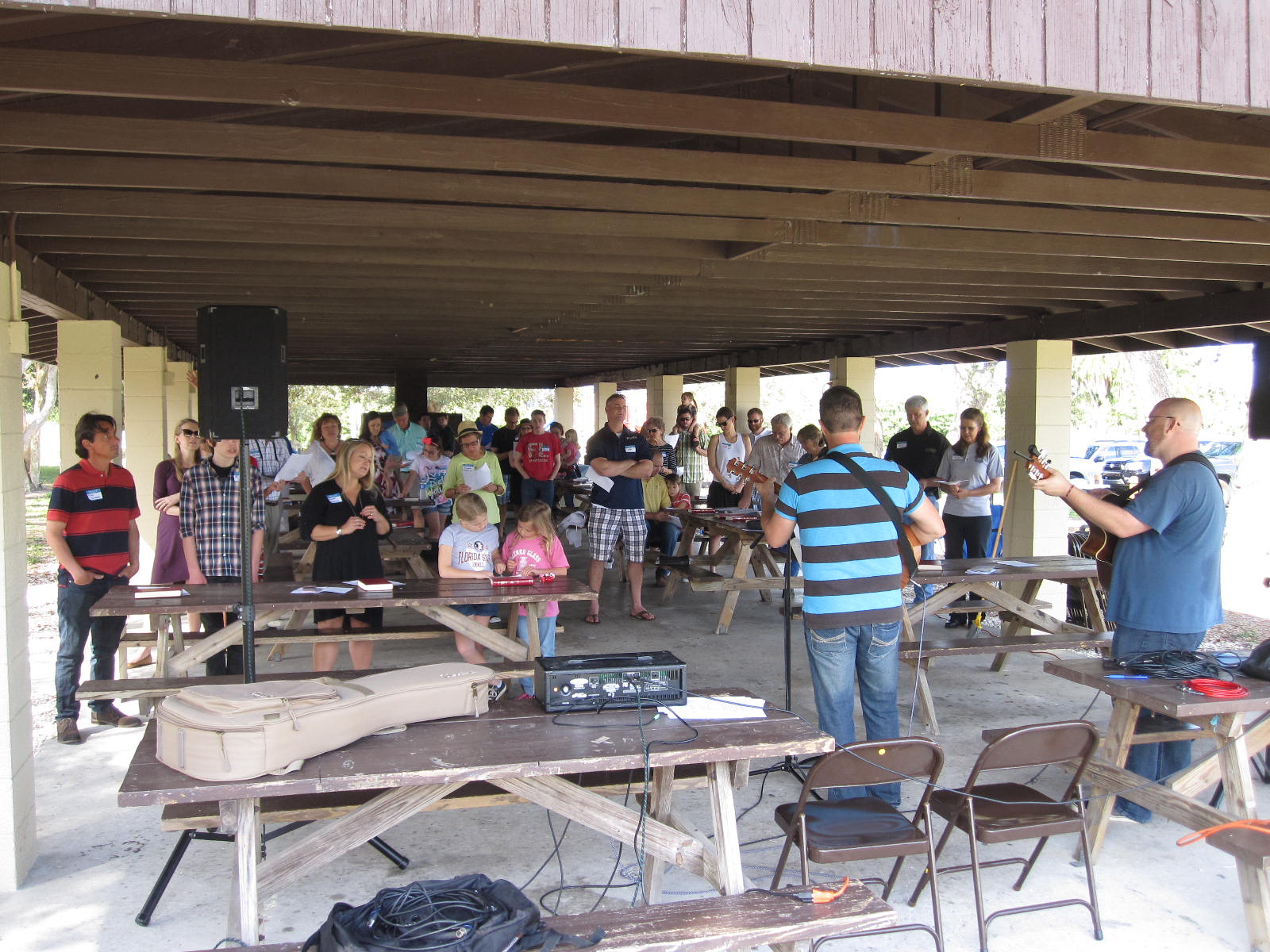
Harbor Community Church just hosted its first public preview service yesterday. It was a blast. Preaching in shorts and flip flops is now crossed off my bucket list! We looked at John 2:1-12 where Jesus turned water into wine and saw how Jesus redeems our shame. Instead of Jesus leaving the party when the wine ran out (as most people would have), he stayed and made more wine. One of the applications I didn’t have a chance to unpack (because I forgot-and probably had preached long enough) was the idea of not leaving a party because of shame. I don’t have the ability to turn water into wine-I’d choose beer anyway-but because I know the one who has covered my shame, I don’t have to leave the party at the first sign of shame.

Jesus stayed at the party and covered this dude’s shame by making sure there was enough wine to go around. If this is indeed the Savior we follow, I think he calls us to stay, instead of leave, at the first sign of shame filled parties and situations.

This is actually quite hard. At the first sign of shame, we tend to run. I know I do. We tend to leave the “party.” But what if we stayed? What if instead of leaving the area we live, work, play, school, fish, we stayed at the “party?” What if instead of leaving an area or party in favor of something less shameful, we stayed and let Jesus work through us to deal with the shame of poverty, drugs, depression, oppression, unbelief, or anything else on the list? Instead of leaving the party or simply staying away from the party by ignoring the shame around us, what if we believed we actually didn’t need to leave at all? What if we believed the one who covered our shame has something to offer folks in the middle of their shame?

What difference would that make to a city, school system, job, neighborhood? Despite the level of difference or impact, I think that’s exactly where Jesus shows up. God certainly does call people to leave parties, neighborhoods, cities, etc…. But since our tendency is to flee shame at first sight, and considering our Savior who stayed and covered shame, its probably wise to consider staying at the party.

Unknown's avatar

Bad kids

It’s been forever since I’ve posted on the blog, but today a discussion broached by my wife seemed like a good place to publicly share some thoughts. We’ve all been around parents who think (or at least express) their kids have almost attained some perfection and that if there were a vacancy in the Trinity, God the Father would come a callin.’ The danger, among many dangers, is that some parents then compare these perfect children with their own kids-and they feel jipped. Of course the perfect child is only a facade. Just like the perfect anything….except Jesus.

But then there is the opposite error, where parents feel their kids are so bad, that they only express that to others. In person, or on facebook. Over time this can lead to a devaluing of the dignity of the child and perhaps preclude the parent from seeing the work God may (if the child is a Christian) be doing in his/her life.

By the way, if you think I’m talking about you, I’m not. This is just inspired by a conversation with my wife today!

The gospel sheds some light on how we speak about our children.

1.) Each child is made in the image of God and uniquely expresses something that perhaps other children do not.

2.) Each child is also a sinner and there reflects something about his need for God through some character flaws. Sometimes those flaws are more private and sometimes more public. The story of the Prodigal Son reminds us that both Sons were equally as lost.

3.) Each child who is a Christian is being redeemed in the image of Christ

Amy’s question was simply this, “How do you publicly or in conversation, praise your kids without presenting some facade, yet also avoid telling others of their struggles or your struggles with them?” I’ll just try to deal with the latter and leave the former for another day.

Here are some of my thoughts. I only have kids that are 5, 3, and 4 months. Each stage has its own challenges. Each stage has its own blessings. For those of you with teenagers, I’m way behind and can only imagine how difficult that stage can be for many of you. These are not gospel, nor are they from Mt Sinai, but simply personal applications and convictions arising from my belief in the gospel.

1.) This may be pretty obvious, as parents we should never rant about our kid’s shortcomings in cyberspace. What if my 5 year old could tweet my shortcomings (and yes I do have a plethora of them!) as a Dad? Pretty scary! Picture this, “My Dad yelled at me today.” #hypocrite #baddaddy

2.) Don’t share your kids’ shortcomings with folks who don’t know you well. They may not have a gospel grid through which they think. Our last community group was incredibly helpful with this. We could let our hair down and admit how hard things could be at times. We weren’t judged for being bad parents, nor were our kids judged for being “bad” kids (yes we’re all sinners but comparatively speaking). Yet we didn’t share our struggles with many outside of this group, because we simply weren’t in a deep gospel centered community with them.

3.) When we do share our struggles with or sins of our children, consider what God is teaching you because of these specific struggles. What sin is this particular struggle bringing out in you? How do you see yourself in little Johnny? For instance, you could say, “My three year old’s tantrums need to stop. But in all honesty, I’m seeing that I too have a temper problem. Here’s what I need to believe to deal with my issue….” How is he/she being reshaped in the image of Jesus. How are you? Share it with those close to you. It will help both parties.

4.) Remember God’s grace in disciplining you. Of course God in love disciplines his children, often using suffering as that discipline to conform us to His image (Heb 12). Yet remember how patient God as a Father is with you. Scales are heavily tipped toward grace and patience! I need to be reminded of this truth every day of my life. Never gets old; don’t let it!

I’m a new kid on the block when it comes to parenting. I love to write but I’ll never write a book on parenting (no one would read it!). I was reminded last night about how complex parenting gets when kids get older. We need community. After our church gets up and running, we’ll be creating an inter-generational Dad’s group where past, present, and future Dads can point people toward Jesus. And once we’ve been pointed to Jesus and his love for us, then try to point each other to practical steps in parenting. The beauty of it all is it will include Dad’s, who because of the gospel, can confidently share and teach from a vantage point of humility and personal failure (and God’s faithfulness). I listen to such folks much better than those who say, “Here’s what I did and it will work for you!’

Don’t know if any of this helps or not. Feel free to share.

Unknown's avatar

Discerning what we really worship

The other day I was reading the Gospel Story Bible with my 5 year old son Connar. If you’re not familiar with it, it’s a great resource. The writers keep the same Christ-centered theme of the Jesus Storybook Bible, but simply include more bible passages. While it does have fewer pictures and slightly more advanced language, it serves as a fantastic supplement or next step up from the Jesus Storyb00k Bible (though even adults like myself find both resources rich and not age restrictive). What it does have at the end of each story are some review questions. And some are not merely “observation” questions-the kind you can answer by simply observing, listening, or looking at the illustration. After discussing the different worship of the Kings of Israel and Judah, the writer asks the question, “How do you know if you are worshiping God or an idol?”

Wow. Great question.

That wasn’t so easy for my 5 year old to answer. Honestly, that’s a hard question for an adult, or simply a mature Christian to answer too. The simple reflex response is always something such as, “I love God more than football, fishing, or fornication.” I mean, who admits or even thinks that he or she loves a sport, hobby, activity (neutral or sinful) more than God. By default we say, God, family, fishing, football. You could fill in the blanks for your life (I simply use football and fishing as a metaphor for hobby/activity/passion).

In Instruments in the Redeemer’s Hands, Paul Trip and Tim Lane describe idolatry as:

“….a desire that rules my heart. My own idolatry is what causes me to be angry. You stand in the way of what I crave, so I lash out against you in anger. This battle over who or what will rule the heart goes on in all of us all the time. What controls the heart will control the behavior. There is no situation or relationship where this battle is not taking place because we all tend to ‘exchange worship and service of the Creator for worship and service of the created thing.’ (Romans 1:25)”

So how do we know if something has become an idol in our hearts?

One simple way is to look at your actions. If you choose to sacrifice your time, energy, hope, commitment to an activity, person, feeling, vision, hope without considering how Jesus views and prioritizes such things in your life, you’re looking at an idol. For instance, if Jesus says _____ about sex, lust, pornography, and you or I choose a different route, then we have worshiped an idol. Or if Jesus doesn’t say ______ about football or fishing, but in order to do partake in those I have to ignore what he says elsewhere about my Christian life, then I have worshiped an idol. We often choose idols over Jesus all the while thinking, “I don’t love fishing or football more than God! That’s crazy talk!” Nope its just our heart talking through our actions, revealing what we ultimately worship.

Connar and I walked through several scenarios together last night. Daddy loves fishing. But if all the thinks about is fishing, that is his idol. If I’m willing to sacrifice regular church worship to take Connar to every baseball tournament under the sun, so that I can get him a college scholarship, then that is the idol I worship. If all you do is play basketball, think about basketball, have a terrible attitude when your team loses, can’t shake hands, fight back when people foul you, then you can know basketball is your idol. Just for the record, I wasn’t that specific and detailed in the scenario.

Of course with Tim Keller’s Counterfeit Gods, he correctly points out that there are idols beneath the idols. For instance, basketball or fishing could be a means to the ends of success, significance, meaning, approval, etc….But first things first.

Don’t be afraid to admit that you love things more than God. He knows it. Jesus died for it. Admit it, confess it, and go back to the one who is greater than fishing, football, or whatever it is for you. You’ll be able to prioritize and re-place your hobbies and passions (fishing and football are two of my passions) to where they are supposed to be. In the end, since idols always leave us empty, and Jesus claims to do the opposite (John 4), you’ll be glad you did. And continue to do so daily.

Unknown's avatar

Reflections from the West Virginia chemical spill

When I lived in West Virginia, the only major weather incidents we had to live through were a few power outages and some really cold temps from time to time (Dec-March!). Recently, my WV friends and church family had the opportunity to experience life without clean water due to a chemical spill. After days of only using water for toilets, the “licorice” smell seems gone and water back to potable levels. Allegedly. It might take a little while before I trusted that declaration.

Facebook posts on my news popped up from time to time. The first came from my former (but currently supporting church) Redeemer Presbyterian. The words, “If anyone needs water, he can come to the church to shower or drink. Our water is clean.”

What an opportunity to simply invite people in and serve them? No strings attached, just meeting needs in the community. Very cool.

But the church also has living water, of which people also need to come and drink regardless of whether that need is expressed in the same physical way (feeling of thirst and really bad b.o. when can’t bathe). I think the same type of mentality should actually be present in thinking about this living water, which is one way Jesus describes himself and what he offers us (John 4). Christians are not better people, simply people who have realized their need and found that need met by Jesus Himself. Of course belief is perpetual and Christians have to continually come back to Christ in repentance and faith.

We have found a place where there is water without cost. There is a safe harbor, a community welcoming other thirsty people who have decided to stop one-upping themselves before God and others, and have instead drunk deeply of the head waters of grace.

I realize many folks reject Christianity because they don’t like the idea of someone being Lord of their lives, or they can’t get around a guy raising from the dead, or even because they think that it is narrow. But I think many still  reject a taste of what they think the gospel is.

The Christian cannot think of himself as better than another, primarily because he isn’t. If he or she can adopt the posture like this West Virginia church and say, “We have water here. Would you like to come and taste it?” I think a number of skeptics might be willing to at least give it a taste.

The church as it gathers should obviously be such a place. But the church as it scatters (individuals and families showing and sharing the love of Christ), should also reflect the corporate ethos. And I’m from afar West Virginians  open up their homes, inviting all who in need (even friends of friends) to take clean showers and fill up their water jugs.

That’s the kind of church many people want to either connect to or investigate. And that’s the kind which reflects its author Jesus. Upon meeting a skeptical man named Nethaniel who questioned whether anything good could come from Jesus’ hometown, he not only didn’t reject him but welcomed him, “Behold, an Israelite indeed, in whom there is no deceit!” (John 1:47). But before he met Jesus, his friend simply invited him to “come and see.” In other words, I met him, and why don’t you come and see if Jesus is who He says He is?

Unknown's avatar

Reflections on preaching without a voice

I had the opportunity to preach at Cornerstone of Lakewood Ranch the Saturday evening, and Sunday morning after Christmas. The only problem was that I had a bad cold/sore throat with very little voice. After I finished the Saturday night service, I told my wife that I wasn’t sure if there were enough voice left for two more services. So I prayed, asked people to pray, drank some tea, and just barely squeaked through. Never been so thankful simply to finish preaching.

Here are some of my reflections on preaching without a voice.

1.) Silently Singing. In order to save my voice, I began “singing silently.” What I mean by that is that I simply  mouthed the words without any volume and thus without further strain on my drained vocal chords. I wasn’t just mouthing “watermelon” or anything; I was reading the words. But something happened that surprised me: nothing. I couldn’t hear myself sing, and therefore, I couldn’t even process what I was “mouthing.” Nothing was happening when I couldn’t hear myself sing. It wasn’t connecting to my head or my heart. Maybe it was just me?  But I had never realized how important it is to at least hear oneself sing (yes, I know I do sing in the least respected “key of H”). I don’t mind loud music in worship. However, when it become so loud that one can’t even hear his own voice, it might be time to turn the dial down from “11” (a la Spinal Tap). How much real engagement might you be having with what you are singing and to whom you are singing?

2.) Personality. “They” say you always want to be you when you preach. I’ll never be Tim Keller, nor should I even try. I need to be me. But when you don’t have much of a voice, and you have to speak monotone to ensure that you’ll  make it through, you can’t truly be yourself. Unless of course you are a monotone speaker. I am not. As a result, I never felt like I could be me. Then God humbled me when I realized that people didn’t need so much for me to be me, they needed God to be God. Holy Spirit illuminating hearts and minds, directing them to glorify the Father by seeing Jesus more clearly. Not me. Not my inflections, excitement, passion, or whatever. God didn’t need me, nor did the people need me. They needed Jesus.

I also realized that if I rely on my personality, not only am I not relying on God, but I’m also limiting whom I reach. My personality may not always fit everyone in a church. But if the Spirit is at work and Christ is lifted up, that can trump even one’s personality.

I hope I never lose my voice like that again. But I’ll be wiser, more dependent, and yet still more confident if I do.

Unknown's avatar

Overlooking mundane missional opportunities while waiting for the spectacular

A few months ago I learned a little about faith in the chair of the dentists office. I also learned a little about a what I perceive to be a common mistake among those who really do want to “make a difference” in this world. The hygenist commented that Pastor “Buddy” (I made that name up because as I pastor I know we can be understood) asked people to think about that “one thing,” that they could be passionate about and make a difference.

Nothing wrong necessarily with that. But the problem that I see sometimes in folks is that they search for something far off on the horizon where they can make a big, noticeable, tangible, and possibly immediate difference in the world. Or perhaps at worst find a reason to justify their existence.

This woman was a single mother. She had a job as a hygenist. Of course she “justified” her job to me, trying to be as spiritual as possible, “by witnessing” to people. It was as though she had to witness every now and then (talk about one way conversation!) for her job to be important.

Now I applaud her boldness, but was simply saddened that she didn’t realize the “spiritual” nature of her business.

My teeth needed to be cleaned. I for one, recognized the worth of what she did!

One of the benefits of having a Reformed worldview is that we don’t see life as a division of spiritual and sacred. A banker, hygenist, stay-at-home mom, a salesman is as “spiritual” as a pastor (provided both are honoring God through their labors) and should be considered as important by God’s people.

Much has been written on this subject so I don’t need to add any more. Here is one such excerpt

God is delighted when you work unto him and find pleasure in your vocation. You are merely doing what he does, after all—working and laboring and creating….As you think and analyze and make things better, you’re showing who you are: a being made in the very image of almighty God.

Instead I’ll simply reflect upon the affect such a division can have: in looking for something spectacular like building a well in Africa, you ignore the “mundane” missional and discipleship opportunities in front of you.

Some (not named Oprah) people will do amazing things like build wells in Africa. And if you feel that is your calling, do it. I’m not advocating ignoring wells in Africa or anywhere. Please don’t misunderstand that!  But you also have a calling as a parent, worker, church member as well. And sometimes in search for something “spectacular,” you miss the opportunities right in front of you. I feel that was the case with this gal.

And to be honest, isn’t working with integrity, friendliness, with excellence honoring to God? Isn’t He our primary audience (Col 3:23)? Isn’t that a way to follow the commandment, “Love your neighbor.” Mundane, I guess, but not all that ordinary. To love your work but not idolize it. That’s definitely not all that ordinary.

What about really discipling your kids and teaching them to live missionally, praying for and reaching out to their friends? What about playing sports for God’s glory and not theirs? What about saying no to sports when they intersect with church?

What about walking around your block and meeting neighbors in hopes that they would one day know Jesus? What about caring enough to bring lonely neighbors together or into your home?

I don’t think that any of those things are really all that ordinary.

As I often tell folks at Harbor Community Church, don’t add anything more to your schedule, just “look” intentionally wherever you live, work, and play. Opportunities abound even without finding that special unique opportunity. It is possible that some very mundane (but I would argue spectacular) things may be right in front of us. And while we are living and looking missionally, God may just share His heart for you to do something you never thought possible “way over there.” As you wait for your mission trip, fundraiser, or whatever, may you find joy as you share in the mundane missional work of God.

Unknown's avatar

Ambushed by a Santa Pharisee in Publix

The other day my three year old Cade and I were going through the grocery store picking out stuff for our neighborhood Christmas party. He had already downed his expected free cookie from the bakery and was in an overall good and helpful mood. He picked up some bagels for me and put them in the cart. Nice work. Nice little helper.

All of a sudden we were ambushed by a “Santa Pharisee.” I heard, “Santa saw you helping Daddy, and I bet you he is going to get you something nice for Christmas! You know, he sees that!”

My first thought was she was stere0typing me. How did she know I wasn’t Jewish? Well not really. But I could have been Jewish, I guess.

What she didn’t know was that we don’t really “do” Santa in our house. Cade had no clue how to respond; in addition to him often even refusing to give a wave-that’s asking a lot! Sure we have a dancing Santa that we have neglected to put batteries in this year. We are not anti-Santa nor are we anti-people-who-are-pro-Santa. But we just don’t talk about him. Connar hears it from everyone else, “What is Santa going to bring you?” We only have so much time so try to ramp up Jesus’ birth as much as possible during Xmas.

But this went further then the normal what-are-you-asking-Santa for type interaction. This crossed into what will you demand/expect in return for your good work?

Cade didn’t know how to respond because he’s three. Connar doesn’t even know how to respond because he knows he’s not real. But guess what, he still loves Christmas. A lot.

Again, we’re not anti-Santa nor do we crusade against Santa. But the more I think about, the more Santa really is a religious figure.

He’s somehow omnipresent or at least omniscient. He rewards good deeds and punishes wickedness by withholding blessings. The only difference between him, Karma, and the standard (not Christian) understanding of God is that Santa dispenses all blessings and curses temporally instead of eternally. Do good and expect blessing. Do bad and expect curses.

Do I really want my kids to do something and then immediately think that they will get a good present? Then they deserve the gift, and it is no longer a gift, it is a wage. Doesn’t that create a sense of entitlement for doing what is simply a good thing to do?

I’m not saying that all parents should break the news to all kids. But making God’s grace a priority in the Christmas season instead of system of rewards-a system that honestly most people never really shake-might be a good place to start.

Perhaps simply talking more about Jesus than Santa would be a good place to start.

Do this and get something good. That’s Pharisaical legalism. Jesus did something good for you when you deserved something bad, so now lets follow him out of gratitude and the joy set before us. That’s grace and the joy lasts a lot longer. Even for little ones.

I’ll never stop being ambushed by people asking my kids about Santa. And that’s OK. I’m not offended. But it does seem like they are talking “religion” when they are talking Santa-at least in the way this lady was. Maybe it will open the door next time to share mine.

Unknown's avatar

What Coach Schiano teaches us about rest, behavior, and belief

This past Sunday, the Bucs wiped the floor-or I guess you could say grass-with the backside of the Buffalo Bills, winning 27-6. Despite the  blowout, rookie Mike “Napoleon Quarteback” Glennon turned in another rather sub-par performance.

So the day after the game, he was back grinding away at the “office,” trying to learn how to be a better QB (keep his job, keep his coaches job, etc….). Coach Greg Schiano immediately sent him home from the facility to rest, or do whatever he would do, if he weren’t a football player.

Schiano claims Glennon has been so working hard that he simply needed a break. In the end, to rest, Schiano thinks, would be more beneficial in his development as a quarterback.

Football is everything for many of these athletes. Of course many wouldn’t say it is everything (“family comes first” or some cliché like that). But how can you tell that what you believe is really what you believe? Or perhaps better put, how do you know if you really believe something? Simple, look at your actions.

All religions call people to live differently and to demonstrate their beliefs by their actions. But those actions in turn do more than demonstrate belief-they garner some response of divine favor and promise of heaven, or at least something heavenly. Christianity views behavior differently. Actions and behaviors are the fruit of a changed heart (Gal 5:22), but that fruit produced by God’s Spirit, does not bring about divine approval or promise of heaven. Divine approval and promise of heaven precede, produce, and motivate actions and behaviors. That’s a HUGE difference. Behaviors indicate a changed heart and the presence of belief in salvation by grace alone.

So how do I know what I deeply believe? Look at my actions.

Now I can’t say Schiano is as deeply concerned about Glennon’s heart as he is with his arm, statistics, and victories (though Schiano was featured in the Christian Sports Magazine “Sports Spectrum”), but he obviously sees what Mike Glennon really believes: football is everything and its okay to be consumed by it. It is only by the action, in this case, resting and taking a break, that Glennon can demonstrate that he truly believes.

Here are some ways that I can know if I really believe the gospel

1.)  Jesus is my everything as opposed to church planting: I can focus on my relationship with Christ before considering what can I do to help this church start/grow.

2.)  Jesus will build this church. While I, and many others will play a role in planting seeds (networking, outreach, evangelism), watering (follow up, discipleship, strategizing), only God can make this thing grow. How do I know if I believe that? I will pray and ask God to do before I try to do. I will make time for prayer if I believe this truth. I will also be able to rest. I will take a day off. If I don’t take a day off, then what I’m really believing is “God doesn’t have this thing, I’ve got to make sure everything is taken care of.” Silly to believe that, but sometimes my actions can indicate that is what I really believe.

Behaviors and actions for the Christian are important, but not important in the same way they are for other religions. They are not meritorious but the fruit of, and indication of what and in whom you believe. Therefore we can use our behaviors and actions to self-diagnose what it is we really believe.