I had been out of my normal daily bible reading the last few days, but fortunately felt both a strong need and desire to get back in it this morning at the airport. Recently I have been trying to carefully study the Christmas accounts in Luke and Matthew. Since Christmas is officially over now, I found it apropos to look at what happened after the Magi left.
In Matthew 2, Herod got wicked angry and gave orders to kill all the children under two years of age in Bethlehem and the surrounding areas.
Two things to note regarding this event:
1.) Anger problems can sometimes be avoided by proper understanding of God’s Providence.
God spoke through a dream, warning the Magi not to return to Herod. It was God’s will that they did not return to Herod. Did Herod know that God had spoken to them through a dream? No, but it was clear to Herod that they would not be coming back to him-that shows God’s will clearly enough.
I was reminded this morning that I often become angry when things don’t correspond to my desire and expectations. Or when people don’t do things I expect them to do.
But looking at this passage, I need to be reminded that they have acted exactly according to the ‘script.’ Hopefully I can relax more and not get so angry. I have no intention of killing a bunch of toddlers, but my anger shows up in other ways.
2.) Even when things aren’t recorded for us in history books, it doesn’t mean that they didn’t happen the way the bible says they did
There is no mention of Herod’s killing these Bethlehem babies in secular writings. Two explanations shall come forth. First of all, Herod did a ton of killing (his wife, mother-in-law, kids, enemies-which he considered to be everyone) that to record every act of murder would be impossible!
Next, Bethlehem was a small town. Scholars think that the town had only 1000 folks (if not half that), and so the number of babies might not have exceded 20. Just a scholastic conjecture, but it is certainly interesting. Jocephus and other historians might not have even known about a tragedy in a small town, or even bothered to record it. Things that happen in big towns always get more publicity.
Sometimes historical documents reinforce what we read in the bible, sometimes they don’t. But it shouldn’t bother us. After all, Jocephus was a turncoat Jew writing for the Romans. In his writings, he tries to justify his turning. He was even more biased than the bible writers. And they weren’t getting paid like he would have been! Just some food for thought for the skeptic (or skeptic in us).
Category Archives: Uncategorized
Some healthy speculation and application
For the last two Christian Ed classes I’ve led, we’ve done a mini-series I call, “Christmas in the Bible.” We looked at the two different accounts in Luke and Matthew, as well as took a quiz on what exactly is and what isn’t in the bible. You’d be surprised how much you assume.
Yesterday, we examined the historical background of Herod the Great and the Magi (the wise men), and had a fun time speculating on some of their heart motivations. Speculating can be dangerous if it is not tempered by community, other scriptures, and a recognition that speculation cannot be confused with special revelation (bible).
However we all found it helpful to speculate a bit to dig a little deeper into these scripture accounts of Christ’s birth and the short time thereafter (Magi found Jesus in a house, perhaps up to 2 years later). Since the Magi were overjoyed, and ‘rejoiced exceedingly with great joy,’ probably knew somewhat of what/whom they were seeking (they would have been very well educated), worshiped Jesus, we found great application this Christmas.
Instead of being bothered by a Bucs loss this morning (which really doesn’t mean anything in the long run, or short run either-they’ll end up the same seed in the playoffs regardless) or all the busyness that lies ahead, I was reminded to rejoice simply in Jesus. Not presents, not family, not the blessings I’ve received, but simply in Jesus’ coming and promise to come again.
We concluded with some reflection on the poem “The Journey of the Magi” by T.S. Eliot. I think this poem reflects his own spiritual journey to Christianity. Here’s an excerpt we briefly pondered. Its an inquiry into what the Magi might have felt like when they returned to the East. I recommend “googling” the rest of it.
All this was a long time ago,
I remember,
And I would do it again, but set down
This set down
This: were we led all that way for
Birth or Death? There was a Birth, certainly,
We had evidence and no doubt.
I had seen birth and death,
But had thought they were different; this Birth was
Hard and bitter agony for us, like Death, our death,
We returned to our places, these Kingdoms,
But no longer at ease here, in the old dispensation,
With an alien people clutching their gods.
I should be glad of another death.
Reflection time
I tried to reflect upon the meaning of Christmas more fully by neglecting my normal sports talk programs. However, I didn’t find that time the least bit helpful. I’m not nearly as contemplative or reflective as I once thought. Car time will probably not be the best reflection time for me. Perhaps it might work for you.
Instead I sat back in my favorite chair and listened to Indelible Grace’s “Your King Has Come” Christmas album. Various artists have rewritten (slightly) for guitar some of the traditional hymns (the good ones-with one exception) and have been very edifying to myself and Amy. I highly recommend this CD.
Some pictures
If you would like to see some more pictures from our Xmas Cookie Outreach, click here
It might give you a better picture of what went on. Pun intended.
"How Silently, How Silently"-that doesn’t sound like a Christmas song, does it?
A church administrator commented to me today, “As I was preparing the bulletin for Sunday, and reading the lyrics to ‘O Little Town of Bethlehem,’ I was struck by the words, ‘How silently, how silently…'” To her, Christmas time has been and is normally anything but silent. She pondered the question, “Where have we gone wrong?”
Its easy to play the cultural blame game, but it is our fault for being influenced by it. So another question to ponder is this: “How can Christmas time be more silent?” Not necessarily silent as in the absence of all noise, but ‘silently’ as in the absence of that noise, activity, that drives our focus away from the celebration of our Messiah’s first coming and anticipation of His Second.
For example, listening to good Christmas music (if you’re a reader of this blog, you know what I think is good and not good; but each has freedom to decide for him/herself!) can be extremely devotional, uplifting, reflective, and even challenging and convicting.
And not all activity is bad; in fact, many Christmas related activities are good. We recently had a Christmas party for our comm group in which we invited neighbors and friends without a church. Another comm group went caroling to elderly members and friends. Even our cookie outreach was stressful to organize, but everyone who participated found deep encouragement and a real Christmas joy in participating.
But there are some potentially (I also think they can be good with proper heart bad motivations) noises/overstressing activities in my opinion. The loudest noise/activity for me is shopping. Don’t get me wrong, I like buying gifts for family. But figuring it all out, running all over town; it never seems to end.
Getting stressed by Christmas shopping for Xmas presents a bad noise, which moves our focus away from joy and onto the stress of figuring out whether you spent enough or how well the gift will be received, or what the next person needs. I really haven’t figured out a remedy for this yet. Is it better to spread out your shopping, or just endure all of the stress in one day? I don’t know.
Perhaps a remedy would be to just draw names. Instead of shopping for small presents for a bunch of people, you might just get one or a few expensive things. That would certainly help my spirit during this busy time.
Today, I’m planning on not listening to any Sports Talk (one day out of the year isn’t too bad, eh?) when I drive and I will simply try to reflect the two important aspects of Christmas: His Coming, and His Return. I’m not punishing myself, nor am I performing some radio-less act of self-flagellation; I simply feel a need for some silence in my busy world. I’ll let you know how this exercise goes.
A curse is a curse of course, of course, unless the curse is "The Curse"
I would truly be doing the Tampa Bay Bucs a disservice if I did not blog about the extraordinary happening at Raymond James stadium on Sunday. After 1865 kick-off returns, a Bucs kickreturner finally returned one ‘to the house.’ The simple law of averages would seem to allow for this to happen about once a year. But once in 32 years?
Nevertheless, the timing was perfect, or close to perfect. I actually never thought it would happen. It seemed like the Bucs were under some sort of curse, and I really kind of believed it. So whether there was an official curse or not, the ‘curse’ has been broken. And how appropriate because Christmas is a time when we celebrate ‘The Curse’ being broken.
‘The Curse’ started back in Gen 3 when sin entered into this world of ours. The serpent was cursed, the ground was cursed, and both the man and woman had to endure the effects of this curse, because they were both responsible for it (however neither Adam nor Eve were actually cursed by God-look it up if you don’t believe me).
Jesus then becomes the ‘seed’ or ‘offspring’ of the woman who would crush the offspring of the serpent-ultimately foreshadowing a victory over Satan by means of the cross. But Jesus, this ‘seed’ or ‘offspring,’ didn’t stop with His triumph at the cross and resurrection. In fact, He will one day crush Satan under our feet (Romans 16:20). And that is one more thing we can celebrate at Christmas.
What it looks like for Jesus to crush Satan under our feet is captured in the popular Christmas hymn “Joy to the World.” By the way, most Christmas hymns have some incredibly profound, and theologically rich lyrics. Check these out:
No more let sins and sorrows grow,
Nor thorns infest the ground;
He comes to make His blessings flow
Far as the curse is found,
Far as, far as, the curse is found.
Jesus’ coming was the beginning of His work, and He will one day extend his blessings as far as the curse is found. One day we shall have a world without ‘The Curse’ (what that means for fishing, I don’t know yet). But this the distinctly Christian hope, and one more reason to celebrate, pray, and long for The Return of the King.
Does Jesus get a fair deal?

On a Christian radio station trying to raise money, my wife heard something a bit unsettling. The emphasis was on the blessing of giving. Certainly giving is a grace of God, and it is also a blessing for the one giving. There is joy in giving, and God gives that joy, and He loves a cheerful giver (II Cor 9:7).
But the emphasis seemed to be placed (I didn’t actually hear it myself) on what you get back when you give. Now I could spend much more time on this, but the ‘advice’ from a DJ took a different turn. If we give, we get back something in return that is of great value. For example, look at God. He gave Jesus and He got ‘us’ out of it.
In case you don’t know by now, you can argue with most things people say, and often find out that the real problem is either semantic, or the fact that the person cannot say everything-and is merely trying to something specific and apropos to the situation. For instance Paul wrote Corinthians and Galatians to different audiences, with two different emphases: one has more emphasis on justification, the other on living consistently with our justification. Its the same gospel applied to different problems in different churches. We can’t say to Paul, “This is true, but you left out this part.” No, he said what needed to be said to that particular audience, and left out what didn’t need to be said.
However, I think this issue is slightly more than semantic and perhaps touches on a deep church cultural problem. God the Father gave up His only Son as a sacrifice. It was a great sacrifice. It was not as though He-though if you want to get Trinitarian and technical, Jesus received the Church (John 10:29)-was getting something of equal or greater value (sounds like a coupon) when He received the church.
A wise person once declared a great error in our normal everyday thinking: “We think we are ‘the SH*T (in case you aren’t aware of this colloquial, it means awesome, or the best). And don’t we? Do we think that God made a fair trade? That we are worthy of this great sacrifice of a Savior being born in a feeding trough and crucified on a cross?
If we fail to see the depth of sacrifice, we fail to see how great we are loved. It wasn’t a fair trade-I can speak for myself. I was not worthy to be saved. However, Jesus would never say I , or you, weren’t worth it.
Instead of hopes of a fair trade, he came out of his great affection for His people and His own glory. And while He would never say anyone was worthy (deserving-before or after salvation) to be saved, I guarantee you he would say “I’m glad I came down to save sinners. It was worth my sacrifice.”
The greater we think we are, the closer it becomes to being a fair trade. The closer it becomes to being a fair trade, the further away from love we get: not only His love for us, but concomitantly our love for Him. He simply, and amazingly, puts His love over His children, like a Father/Mother puts his/her love over a newborn child. And I’m glad He does.
When old doors truly close on you
Here is another example of God closing doors which I desperately wanted opened, and opening doors which I hadn’t thought much about. As good as Sunday was with our cookie outreach, Friday was that bad. Well, kind of-but not a ‘serious’ bad, more of a ‘frustrating’ bad.
I invited another young couple from church over to the house to eat some snook (the same snook pictured on this blog). So I had already begun thawing the meat when I get the call that his wife was too sick to attend. With Amy not eating much fish, I didn’t know what we would do with all that snook (it was one whole fillet of a 30 inch fish).
I started calling, and ended up with about 5-6 different “No thanks” for a last minute snook eating invitation. Only one was even close to saying yes.
Then I go to the gym, and I get word that it will be closing down. That day. Where would I work out now? I was actually beginning to meet more and more people there. I wondered why God would just take this away. I had grown fond of the gym I once loathed.
No one knew what would happen. Getting the truth out of the few workers left was about as easy as getting the truth out of a baseball player accused of using performance enhancing drugs. And I had no power to play the perjury card.
I cut my workout short because I was so disgusted with the gym ownership. I really wanted to call the newspapers, the TV News channels, and give this owner some negative publicity.
Then I asked my workout partner if he wanted to come over to the house and eat some snook. He said yes, and then I invited one more person whose wife was out of town. So we had 4 over to the house to eat the snook which I was uncertain how to prepare. This no fried food thing for Amy is killing my style. However the baked snook was world class good. The evening was a blessing for all.
On Monday I drove up to Fusion Fitness to see what was up. It was surely closed. But lo there were Lifestyles employees there to answer questions, and like angels, herald the good news. I am now a Lifestyles member. Lifestyles (aka Glob0-gym) bought out Fusion Fitness (Average Joe’s). Praise God I didn’t cancel on Friday afternoon! Basically I upgraded for free, with the same terms of contract in a nicer place.
I only hope that those I had begun to get to know will see me at the Lifestyles gym. If not, I’ll just meet and build relationships with those whom God puts before me. Closed doors can be frustrating, but they are never truly ‘bad.’
Xmas Cookie Outreach
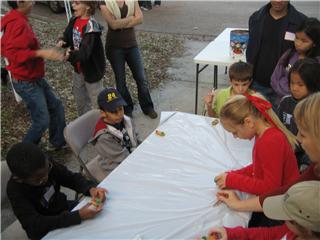
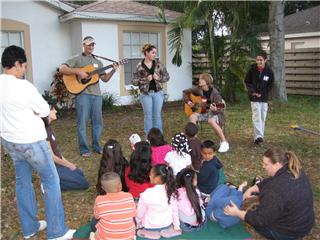
I’m still pretty high right now. Not drugs, not hugs, just kind of an emotional and spiritual high. Yesterday, we had our neighborhood outreach cookie/craft decoration thing. We invited neighborhood kids (we had 2 families come), Amy’s kindergarteners (close to 10, and some of their siblings), a number of our church kids, and those invited by our church folk. It was amazing (25-30 kids).
There were so many little things that God worked out to make it run as smoothly as possible. Amy and I borrowed the pastor’s big blue van and picked up 6 kids at 5 houses. Fortunately Amy called the parents on Sunday, and reminded them that we were coming. Miracle of miracles, they actually called back. Some were surprised, some couldn’t come, others would be coming but THEY wanted to drive them here.
That was great news. Finding these houses was not easy, and took a long time because they were all spread out. It was great news to hear that we would only need to go to 5 houses, not 8! Had we gone to 8 we would not have made it back in time to get some last minute things ready.
But we found all of them-mapquest was actually accurate. We took on some enemy fire when driving through one of the neighborhoods (rocks or something else hard). But those kids were gone when we returned to drop them off.
We used the symbolism of the candy cane to share about Jesus, and offered a possible name change if they only would turn it upside down: Jesus cane. We also tried to teach them “Silent Night.” The other two stations involved making donut snowmen and reindeer cookies, and decorating a bag to house their creations and our Xmas Eve invitation.
Everything ran so smoothly, particularly when you think of 25-30 kids, 15 or so adults, 10 youth, other parents of kids. I bet we had at least 50-60 people in my yard, cul de sac, or house! On Sunday I thought this would have been a good idea if we hadn’t invited Amy’s kids. It would have been more manageable. And it might have. But God ‘managed’ everything, working behind the scenes.
One report from a member came today which spoke of a young girl understanding the importance and symbolism of Jesus and the candy cane. Another neighbor told me how grateful she was that we do things like this and neighborhood cookouts. I spoke with several neighbors and warned them of the activities which would be going on. Fortunately they were cool. Forget Robert Frost’s saying, “good fences make good neighbors.” Communication, community, love, regular prayer, and of course God’s grace and providential involvement make good neighborhoods.
Did Zecharaiah get the shaft and Mary a pass?
In the mornings I’ve been reading very carefully the Christmas accounts in the gospel of Luke. One thing that really had me puzzled was the difference in angelic reactions to Zechariah and Mary. I mean, it was Gabriel who delivered the message in both cases.
In case you’re not aware, Zech was the father of John the Baptist. While offering prayers, most likely prayers on behalf of the people (not a personal prayer for a son, since he was a priest), an angel appeared to him. Like all people who see, or would see an angel today, he freaked out.
But good news soon came to him that he and his barren elderly wife would bear a son. So he asks, “How shall I know this? For I am an old man, and my wife is advanced in years.” The angels response is basically, “You let God figure that out. Just go on home and get on with your marital privileges.” But since he didn’t believe at first, God shut his mouth until the child was born. No talking for 9 months. Wow. Can you imagine that?
Well, Mary asks a question that seems very similar to her, and the same, unsolicited angel: “How will this be, since I am a virgin?” And the angel obliges her with a simple answer (although it really doesn’t make any logical sense-‘power of the Most High will overshadow you’) and reminds her that “nothing is impossible with God.”
Is this a double standard? Do young lasses get a pass while old priests don’t? Does God expect more out of old priest than young ladies regarding faith? Is this angelic affirmative action?
After looking at the passage in length, and looking up a commentary, which was largely unhelpful (that’s why its good for pastors to have 2-3 per bible book), I will, as George Mitchell did yesterday, report my findings. While the verbiage of the two questions in question look very similar, I think perhaps the heart behind the questions might have looked very different.
With only written words, we are not privy to tone, which I’m learning in marriage, makes a HUGE difference in communication. I don’t know what Zech sounded like when he questioned the angel’s good news.
Ultimately though, I think that what we have is the difference between doubt and a simple question of ‘how’ or “Am I hearing you correctly?” Zech could have been more of a “Yeah, sure, whatever” or “How am I supposed to believe that?” versus Mary’s “How will that happen-I’m still a virgin and I think I should stay one until I’m officially married.”
But another explanation can be found if we simply look at the scenario. An angel brings great news, good news not only to YOU, but to your nation, and to the world. You can imagine the joy in which it was brought. And then the dude you’re bringing it to says, “How am I supposed to believe that?” I’d have shut that joker up for a lot longer than 9 months!
Regardless, there was more a difference in heart than exactly what was being expressed in words. And the issue of the heart has always been what God cares about. It is the heart which God looks at, not simply the words being expressed. The heart. “More than words,” said one early 90’s band called Extreme.