Unknown's avatar

Sadly sovereign, mostly sovereign, and mostly believing sovereignty

Christians, at least in America (since I don’t know a ton of Christians outside of America I’ll limit my target audience to those I actually know) really struggle with the idea of God being Sovereign. Now few people struggle with declaring God is Sovereign, since that’s exactly what the bible tells us about God. But when it comes to actually what God is sovereign “over,” well that’s when two paths diverge. I’ve “chosen” (or have I?) the road less traveled, but many folks really believe in a limited picture of God’s Sovereignty. 

For instance, my son’s preschool lays forth some of its theological convictions, one of which is “God is Sovereign over all things.” But what they really mean is that God is Sovereign over all things except my individual choice to repent and believe. That is off limits. God does not choose people, God’s people have chosen Him. This is an arena God can do nothing about. So in essence God is only mostly Sovereign (still better than slightly sovereign I presume). 

Yet for those who would profess that God is in total Sovereign control over His universe (Psalm 115:3; Psalm 135:6), there is still yet another bigger problem. Believing it. How do I know if I am, at the moment, truly believing God is Sovereign? Here are some diagnostic observations I’ve been personally working through (well before, but also during the election) to discern how much I really believe.

  • I might be saddened by a decision/outcome, but will not be depressed by it. 
  • I will be angered by an injustice, and it will move me to prayer and action, but I won’t be disillusioned by sin’s presence. Sin’s presence will be with us until Jesus returns.
  • I will be frustrated by an event or outcome, but instead of a fatalistic apathy or uber-introspection, I can evaluate and discern what can be learned for the future
  • I might be angered by the actions of others, but it won’t stop me from loving them

For a more thorough look at the idea of “God is in control” as it relates to the election, I commend to you the article of a friend and fellow PCA pastor

Professing God is Sovereign is the easy part; believing God is actually Sovereign is hard part. Very hard. I’m a decent theologian but not very good at applying my theology. That’s what my frustration, anxiety and blood pressure levels reveal. They reveal a disbelief that God is both trustworthy and sovereign. 

This part has much less to do with the election and more with the presence of evil in the world and our moving into it.

There is on often overlooked aspect of God’s Sovereignty: that God can ordain something that brings him sadness (though not regret). Think about God not delighting in the death of the wicked (Ezek 33:11). Think about the cross. That did not come about by accident but by God’s decree. Think about Lazarus’ death in John 13 and remember that Jesus could have come sooner, but chose not to do so. Yet he wept. An intentionality, plan, and purpose, but not without tears. Think about the way a father has to discipline a son, being in total control of that discipline, yet he is sad that it has come to this point. 

I think we need less an answer as to why we suffer, and more a dynamic relationship with Sovereign loving God who also weeps with us. One of my favorite preachers, Martin Ban of Christ Church Santa Fe, reached this conclusion, even though I disagreed with how he got there. The why is less  important than the Who.

God’s Sovereignty doesn’t mean that God simply coldly ordains. He is not subject to emotions the way we are, but we cannot assume that things which always fall out according to His plan are without any divine “tears.”

Unknown's avatar

Don’t waste your clout: a high school QB and a gal with Microcephaly

Sometimes athletes, particularly in high school can really be jerks. And sometimes, being a jerk is what they do on a nice day. Yet every so often, one hears (now you can hear-if you hadn’t seen this) of a story where the athletes aren’t the bullies; they are the defenders of the bullied. The story can be found here, and you’ll want to read this one. I know I always say things like that, but this one is a heart warmer. It really is.

A mentally handicapped (microcephaly) gal named Chy was getting made fun of, for guess what, being mentally handicapped. Cue blood boiling…..So her mother resorts to faculty, principal, militia? Nope. She goes to the quarterback of the football team.

Now that Carson Jones agreed to do something about it, he would probably just bully the bullies? Right? Not this Mormon.

He started asking her to eat at the cool kids’ lunch table with him and his teammates. “I just thought that if they saw her with us every day, maybe they’d start treating her better,” Carson says. “Telling on kids would’ve just caused more problems.”

It got better. Starting running back Tucker Workman made sure somebody was walking between classes with Chy. In classes, cornerback Colton Moore made sure she sat in the row right behind the team.

Just step back a second. In some schools, it’s the football players doing the bullying. At Queen Creek, they’re stopping it. And not with fists — with straight-up love for a kid most teenage football players wouldn’t even notice, much less hang out with. 

1.) Don’t waste your clout

This Carson Jones fellow had been given clout. A QB has clout. He has influence. Instead of using that influence to advance his own agenda, Jones used his clout to see that this young gal was enfolded into the “cool” group. There she could find refuge from the bullying, acceptance, and love. Popularity, clout, influence, in and of itself, is not bad. You can use your clout for good. You can use your clout to advance Jesus’ Kingdom purposes. I think more important than this kid being a QB was this kid simply offering himself in relationship to someone who needed it. When people are in need of relationships, and you choose to offer yourself to those oppressed and hurting, that’s all the clout you need.

2.) Fighting with love 

If I were the mom, who knows what I would have done? I can’t imagine someone mistreating my child and not ordering the high school equivalent of a “hit,” something like an atomic wedgie, toilet swirly, paintball raid. But this kind of sentiment is only partly correct. We should be outraged and angered at the evils perpetuated through words. And we should fight back. But the question is how? The Taliban blow themselves and others up, but I heard one missionary describe our redemptive activity in the world as “suicide bombers of love.” We fight back with love. We don’t fight fire with fire, but with water.

Not a sappy sort of love which simply laments or votes against injustice, but one which actively moves into the world of the oppressed. Something costly. Bringing those oppressed folks into a new relationship. Our relationships. There is always a cost when it comes to bringing someone into our relationships. Relational dynamics change, and that’s a cost. The cost of taking on the smell (smelly kids/adults tend to have fewer friends), the risk of loss of reputation (will we be as liked when associated with ___?), time, money, convenience etc…

3.) The cost is still worth it. 

But what about next year, when Carson probably will be on his Mormon mission and all of Chy’s boys will have graduated? Not to worry. Carson has a little brother on the team, Curtis, who’s in Chy’s class. “Mom,” he announced at the dinner table the other night, “I got this.”

Just because something is costly, doesn’t mean that it’s not worth the cost. Jesus instructs us to count the cost (Luke 14:28), but what we get is a joyful treasure (Matthew 13:44). The younger brother saw the cost, but deemed taking care of this gal very much worth the cost. Many times the cost of sacrificial love scares us away from, well, love. But consider the fact that the cost may be worth it. Whether it be as simple as sticking up for the unlovely, or as sublime as adoption, we can’t forget that the blessings of following Jesus do not only start in the life to come (Mark 10:30).

Unknown's avatar

Your words about and prayers for politicians matter

I had some professors at Furman University I liked. I had some that I did not like. I had one, while on foreign study in Italy, that I actually hated. He made fun of Christians. If we asked a question that had anything to do with Christianity and the Romans (our class was cultural diversity in ancient Italy-a pressing issue of our day…), we were ridiculed. Of course there were other reasons we hated him, that were more academic, literally. He was harder and more strict than the other professor on the trip. So what did we do with that hatred, which we presumed to be justified; after all, he hated Christians and made fun of us? He told us that the reasons the Romans persecuted Christians was because Christians were intolerant. Makes a lot of sense, doesn’t it?

So we got together in a small group and blasted him verbally. It was a small group of Christians dominated not the gospel of grace, but by a common hatred for a fellow lawbreaker. Not too long after we got together and vented against this tyrant, the Holy Spirit began to convict us individually. We eventually stopped and pursued more sanctified means of protest and complaint within the proper channels when we arrived stateside: the dean of the school. 

Today I read this passage in Titus 3:1-2

Remind them to be submissive to rulers and authorities, to be obedient, to be ready for every good work, to speak evil of no one, to avoid quarreling, to be gentle, and to show perfect courtesy toward all people.

I wonder if our little “bash sessions” on foreign study were all that unique. I think the general gist of them probably continues with most long after we graduate college. On to bosses. And eventually on to presidents. As Tom Hanks in Saving Private Ryan reminded us, “gripes go up.”

Isn’t it amazing how easy it is to get together to bash people who promote or perpetuate what we deem is evil? And sometimes we are right. Sometimes what we bash really is evil, so we feel the right to bash, trash, gossip, slander, make fun of the person behind the evil policy. I don’t think we have the right to run our own “smear campaign” behind the scenes.

But how often does this command to “show courtesy to all people” and “to speak evil of no one” really enter into our politically charged impromptu “bash sessions?” This would probably be easier if we actually took seriously Paul’s instruction to Timothy in the 2nd chapter of his first letter to him.

First of all, then, I urge that supplications, prayers, intercessions, and thanksgivings be made for all people, 2 for kings and all who are in high positions, that we may lead a peaceful and quiet life, godly and dignified in every way. This is good, and it is pleasing in the sight of God our Savior, who desires all people to be saved and to come to the knowledge of the truth.

I stink at this prayer. I sadly confess I rarely ever pray for the president. And its not because who I want isn’t in the white house. I’ve just not figured it was very important. But as I’ve gotten a bit older, who is in the white house has become quite important to me. I will not be happy if Obama is elected, and this is one of the first elections where I genuinely care. Because I care, and most people do, these two passages become highly important.

One reminds me that my words about our president are important. My prayers for him are just as important. Thanks to my nifty Prayer Notebook App, I now have a category and will be regularly praying for our president, whoever that may be. I trust that my prayers for our presidents and leaders will then lead me to speak less evil of them personally. Pray despite evil in order to speak less evil.

Unknown's avatar

Breaking Sad: Last thoughts on Breaking Bad

I recently finished the series Breaking Bad with my wife.  Now I’m Breaking Sad because NetFlix only has the first four seasons. Several folks told me to give the show a try, but I resisted, based on the simple fact that the show is about a chemistry teacher turned meth “cook.”

But after a number of my Christian friends actually told me to check it out, I decided to give it a shot. We got hooked very quickly. “Must have been love, but it’s over now.” Roxette once sang that. I feel her pain.

There are a number of shows out there dealing with issues that aren’t illegal. I tried several. And there were others I wanted to watch, but instead felt convicted after the first few minutes that I shouldn’t be watching them. But what makes one suitable and another one sin (at least for me-Romans 14)?

I think most Christians fall into two categories. Don’t watch anything “secular” unless we’re talking about Americas Funniest Home Videos. Or they choose what I call “the route of the oyster” and watch anything you want to watch and therefore suck in any “teaching” without thinking.

Here are some reasons, outside the the fact I appreciated the acting, writing, storyline, why I felt Breaking Bad was more than enjoyable, but instead devotional. They aren’t from Mount Sinai but the Valley of West Virginia. Yet perhaps they could be helpful to serve as principles to help guide us through the sometimes difficult process of discerning what shows/movies we watch…..

1.) Does the show glorify a particular sin?

In Breaking Bad, I found nothing glamorous about the whole meth making/dealing process. Duh…Of course there is money to be made, and lots of it, but the reality is that this “get rich quick scheme” ended up creating new problems (people asking where did the money come from, more crime like laundering, threat of death, more lying, murder, etc..). Ironically in order to provide for his family, the main character Walt actually destroys his family, hardens his heart, harms little children, kills people without thought, etc….It was kill or be killed, always looking over shoulder. Nothing glorious about meth. Walt becomes the kind of person he initially hates and judges. The specific sin of drugs only hardens and hurts himself and others. Know drugs, No glory.

2.) Does the show tempt you toward a particular sin?

Obviously no temptations toward Meth, only confusion how folks think meth is a good idea.

3.) Does the show expose sin, in any way, for what it is: rebellion, idolatry, deceptive, destruction/decay/death?

One of my greatest appreciations of the show is how it exposes Walt’s insistence that this drug making, and the affects of it, were only his problem. Breaking Bad really debunks the popular myth that an action is really only bad if it harms another person. That’s impossible. Each “sinful” action has a harmful affect on those within one’s community. Stealing affects the person whom the object was given. Affairs negatively the cheater, one cheated with, the children and husband. Lies destroy marriages and harden one’s soul to where one can then justify everything. Walt allowed a gal to overdose on drugs when he could have saved her. That in turn led to a horrific plane crash. Sin brings harm to individual and community. All sin does. Jonah ran from God and each step took him further away from life. Walt’s sin did the same thing.

In addition, there was really a greater sin behind Walt’s meth making: pride. Walt makes Oedipus’ “hubris” look like mild in comparison. Drugs and money were merely, as Keller calls them, “Surface idols.” Walt sought money and making drugs in order to be meet his need to be seen as successful and independent of others. Money simply provided this temporary prideful “success” and “independence” for him. To the discerning eye, the outward sin was only a symptom of a deeper heart idolatry of pride.

4.) Is there any positive takeaway or opportunity to discuss with neighbors or fellow believers?

On several cases, characters are placed in moral conundrums but have no real basis other than a feeling for whether something is right or wrong. Walt’s wife reacts disapprovingly against his incessant lying to her, but then she decides to make up a story for how her husband has so much cash. She used to think lying was wrong, and not reporting income was wrong, but she later participates in a money laundering scheme. A man who has been concealing income from the IRS, later refuses to pay off the 600,000 he owes the IRS with money he believes is obtained through gambling? He says he just doesn’t feel right about it. Walt once asks, “Where do we draw the line?” The show clearly shows the inability and inconsistency of an ethical system that is not based upon some overarching standard. Now it doesn’t reinforce God as that standard, but it does seem to raise the question: if there is no standard, can we really deem something right or wrong?

I see great opportunities for discussion in future.

5.) Is there anything clearly redemptive? 

At one point, Walt is actually broken. For a short time. His son sees him crying. The next day the father says, “Don’t ever think of me like this.” The son responds, “This is the best I’ve seen you in the last year and a half. You were real, authentic.”

Brokenness over sin-though this was merely brokenness over the consequences of sin-is a beautiful thing to the world around us. Jesus reminds us of its necessity in our posture before God as well as others in the Beattitudes: “blessed are the poor in spirit, and blessed are the meek….”

Just for a moment, there was something clearly beautiful…..

If we watch TV shows like an oyster and just suck in everything without thinking, we will do ourselves and families harm. But if we can actively discern messages in shows, and ask several key questions, they can be more than entertainment for us. They can be devotional and evangelistic. 

Unknown's avatar

Kathy Keller on hermeneutics, ladies, and misinterpretation

A number of months back, blogger/speaker/writer Rachel Held Evans shared a number of reasons why she became disillusioned and left the church. I deemed this a helpful list, and even responded to that list here, here, and here,  though I obviously disagreed with her conclusions. Later she shared a list explaining why she returned to the church.

Now she has a book out called A Year of Biblical Womanhood: How a liberated woman found herself sitting on a roof, covering her head, and calling her husband master.

Apparently her publicist must have done some good work as Evans ended up on The Today Show. But do not count Tim Keller’s wife Kathy among her fans. I commend her review  called “A Year of Ridiculous Biblical Interpretation.”

Whether you intend to read Evan’s book or not (I don’t unless folks in my church start reading it), do yourself and your friends a favor and read the review, if for nothing else, then its sound, simple, but helpful lesson in hermeneutics. 

Hermeneutics is simply the method of interpreting something, though its use is often employed in reference to bible interpretation. Kathy gives several parameters which will help you interpret the bible. According to Keller, one of Evan’s main contentions with so called “Biblical Womanhood” is that primarily folks are simply picking and choosing which bible verses to apply. Yet Keller wisely recognizes in her review/open letter,In doing so, you (Evans) have further muddied the waters of biblical interpretation instead of bringing any clarity to the task.” Here are a few things we can glean in regards to how to more responsibly interpret the bible.

  • Interpret the Old Testament with the new. Jesus fulfilled the ceremonial law and so we can eat bacon wrapped scallops now. It is not picking and choosing to not follow dietary or cleanliness  laws (Mark 7:19)
  • Narrative or Prescriptive? Is the author telling the story to condone/approve/teach evils (prescriptive) or does he include the “dirt” of God’s people to show everyone that even the “heroes” need a savior. Is Abraham’s passing off his wife as his sister to save his butt something the bible approves of/instructs us to do (prescriptive), or is it a display of a lack of faith ultimately displaying our need for Jesus? The writers no more condone or approve of evils perpetrated on women than a newspaper editors approve of a rape or murder they report. Nice one Kathy!
  • Intended meaning in context. What is the writer trying to communicate? She gives two examples. One includes a misapplication of proverbs as she literally stands on the corner of the street with a “Dan is great” sign when the text of proverbs reads, “Her husband is respected at the city gate.” It just means the husband is generally respected in the community. The 2nd is when Paul explains to Titus that even one of the Cretans own prophets declares that they are lazy. Paul isn’t being a racist, but instead reminding Titus that he his work cut out for him and their own prophets agree!

While Evans espouses a how will we pick and choose bible verses to apply, this is not how, even the bible writers, assume one should interpret it. In the end, hopefully one of Evans “gifts” to the community will be a heightened awareness that each person needs to  examine his heart when coming to any subject matter addressed in the bible. We should do all we can to make sure we aren’t picking and choosing which ones to apply. Unless of course, Jesus tells us specific ones (ceremonial law) not to apply in the ways they were first intended.

Like I said earlier, read the review, if only for the hermeneutics lesson. It’s well worth your 5 minutes or so.

Unknown's avatar

Making your own "study bible" and some prayer apps

My last post focused on how not to use your cell phone during corporate worship. But recently I have come across some helpful ways to use technology in and outside church.

1.) All kinds of tablets offer various versions of the bible. Provided you can resist the urge to check facebook or update your fantasy football roster, tablets can be quite helpful. A woman in our church actually takes notes within the electronic bible app. So in essence she is creating her own “study bible” whenever she hears the word preached. Since we at Redeemer preach expositionally through books of the bible, she will have “commentaries” on various books or sections of scriptures (like the Sermon on the Mount which I’m preaching).

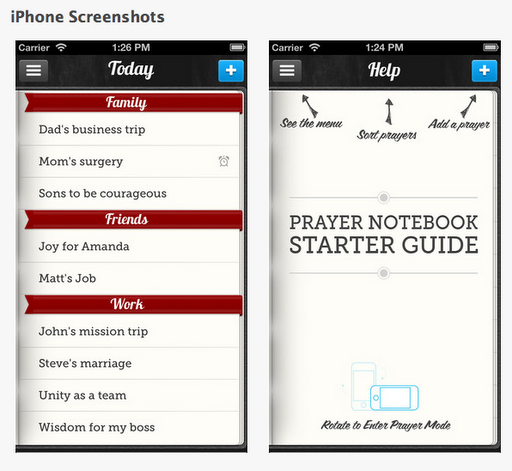
2. I’m not very technologically advanced compared to most, but I’m still benefiting from the Prayer Notebook app. Tim Challies recently shared a number of prayer apps for iPhones here and I ended trying the free version of the app called Prayer Notebook Lite. After I saw how it worked, I felt it worth the price of $ 1.99.

One of the more convicting things about the app is that I’m now realizing folks I’ve simply not prayed for. But the bright side is that I’m praying for more folks and more situations now. While I’ll never pray for everyone as much as I would like, fewer people are slipping through the cracks. The app allows you to separate requests into categories, days of week, mark as “answered”, and will even send you reminders if you want. Just started using it a few weeks ago, but very helpful, especially for those requests which fit outside my normal categories.

Here’s a screen shot of what it look likes

If you have any other helpful apps, please share them.

Unknown's avatar

Shoud you facebook and tweet during church?

A pastor in Arizona actually encourages social media during the worship service. “What” say you, or at least that’s what I say. I’m a pastor. Is that really a good idea?

Just before The Office took a nose dive in quality, it depicted a beautifully tragic/accurate cell phone addiction scene. Ryan, one of the younger characters on the show had his cell phone taken away during a game of bar trivia. He was cheating with it. After it was taken away, and for just only a matter of minutes, he confessed he couldn’t play the game any longer because, “I can’t live without my cell phone.”

I confess now that I have a smart phone, I use it all the time. I take it places where I probably shouldn’t. But is “having to have it” all times a good thing? My wife says no, and I think I agree with her. And I’m pretty sure Jesus is on her side on this one.

If you watch the short clip, which of course you should, you’ll see a pastor leading his congregation to share the gospel on facebook and other social media. During the service. He argues that the church should be ahead of the times and take advantage of these opportunities.

As one who tends to embrace the pragmatic, I can sympathize with this direction. The Reformers certainly embraced technology in the form of the printing press. They took great advantage of it, and one wonders what kind of influence they would have had without that wonderful piece of technology. I don’t remember Luther or Calvin saying, “I want to go ‘old school.’ Let’s just get some people to hand-write our materials. Helmut or Pierre, you guys have good penmanship, right?” Nope they took advantage of what was out there and used it for the spread of the gospel.

While I love the outward facing direction of this pastor, and the truth that people need to hear the gospel preached each week, my concern is more in regards to the timing of when this should happen. Here are my three main concerns:

 1.) Cell phone idolatry. We’re on our cell phones 24-7. Can we not take a break from them, taking our gaze off our idols (even if we’re using them for good things like inviting folks to church)? Aren’t we more like Ryan from The Office than we want to admit? Who greater to deal with our idolatry than the beautiful risen Savior King Jesus?

2.) Church and worship. Should the church worship service be a time no different than any other during the week? Or is it a once-a-week special time when God’s covenant people gather together to offer up their hearts, minds, time, wallets, voices to serve the God who has graciously saved them and lavished them with grace? Invite people to worship. Ask early and ask often. But when God issues His call to worship Him, just direct your attention on Him as much as is possible. You’ve got tons of time to invite folks over facebook, twitter, text messages, etc….

3.) Are invitations during worship more effective than invitations extended before or after church? Do you really think its more effective to take a picture of yourself singing and then tweet it to others than to send the same message after or before worship starts? Perhaps the most effective communicative tool is asking someone in person. You don’t even need a cell phone plan to do that.

Other pastors have thought through the issues of technology during worship. Some don’t even want power point or media shout. Some think printing words in the bulletin is from the devil (God only wants you to sing out of man-made hymnbooks I guess…). That’s not me. Use technology for God’s glory, our edification, for outreach and mercy.

Use technology but don’t let technology use you. I think someone smarter than myself probably already said that once. Or twice maybe….

If you’re interested why well known Reformed pastor Tim Challies thinks you absolutely should not tweet sermons in real time, check this out. I don’t always agree with him-why do pastors feel the need to always make that disclaimer when its pretty obvious we can’t agree with everyone all the time-but he is very biblical, thoughtful, and “down with the times.”

Next post will be on some spiritual benefits of technology folks have passed on to me.

Unknown's avatar

Implications of believing in Judge Jesus

We have been watching the video Soul put out by Christianity Explored for youth group time. The video and materials that come with it are intentionally evangelistic, so any visitors will get to hear the gospel or at least part of it (the video is 7 weeks long). The benefit for those in the youth group is that they get to better understand it or believe it for the first time. I never assume everyone who regularly comes is a Christian.

In addition the youth are afforded a way to learn the gospel in a way that they can share it in the language of those outside the church, as opposed to “simply” using words like “ask Jesus into your heart” that only people in the church understand. 

But the final benefit of hearing and re-hearing the gospel is that it provides so much application for believers as well. For instance, the video highlighted the resurrection, but spent time explaining one of the “perks” of the resurrection for Jesus’ followers: Jesus is the Great Judge.

Jesus is being “judged” by the high priests, he tells him that they will see “The Son of man seated at the right hand of Power, and coming with the clouds in heaven (Mark 14).” Jesus is ultimately saying, “You’re judging me now, but you will see me judging you in just a bit. And I’m right and you’re wrong.” What irony: that the one being judged is actually the just judge of all!

So what difference does that make? Well the video highlighted some helpful stuff. First of all that no one will pull a “fast one” on God. Jesus will have the last laugh. Not the Taliban, murderers, rapists, etc….

Since Christians don’t stand on their record but Jesus’ record, the image of a Great Judge should provide comfort. But it also makes a huge difference in life. We went a bit further than the video to mine this truth for more application.

Oprah teaches us to not let anyone judge us (meaning don’t let anyone tell you are sinning, even if you are). Paul teaches us to not let anyone judge us according to the new moon or a Sabbath (Col 2:16). I think he means that we can defend our not celebrating new moon or special Sabbaths (not referring to the weekly Sabbath). Don’t cave. Relax. You’re in the right. Let Jesus take care of it.

But what happens when people do judge us incorrectly? What happens when other Christians judge us according to standards not in line with the gospel? I think the Jesus response to the high priest applies for both situations: “you will see the Son of Man seated at the right hand of Power.”

Whether our accusers are Satan and his goons (the great accuser), non-Christians, or Christians, we will all face the great judge. Thankfully.

Give it to Jesus. If we’re right, we’ll be vindicated. If we’re not, we’ll be forgiven. Win-win.

Now that’s not always easy to do. In fact, whenever I’m judged incorrectly (as far as I know), I hate it. It seems so unfair. But it’s not nearly as unfair as what was done to Jesus. And I want to retaliate. Yet ultimately why I demand justice now is that I don’t believe what Jesus says. That’s really it.

But there is also hope in this life too. Consider Paul’s words to Timothy: 

Alexander the coppersmith did me great harm; the Lord will repay him according to his deeds……At my first defense, no one came to stand by me, but all deserted me. May it not be charged against them! But the Lord stood by me and strengthened me, so that through me the message might by fully proclaimed and all the Gentiles might hear it. So I was rescued from the lion’s mouth. The Lord will rescue me from every evil deed and bring me safely into his heavenly kingdom. To him be the glory forever and ever. Amen.

-II Tim 4:14, 16-18

That perspective can be ours when we believe. Lord give us faith to believe.

Unknown's avatar

I’ve accepted who I am: I’m bad

My wife and I have been making our way through Breaking Bad on Netflix. As we are approaching the middle part of the 4th, and I believe, penultimate season, I’ve actually noticed a number of “common grace” (beneficial things non-Christians display and do) and fairly biblical insights. Let me share with you one particular questions that the series raises, and then answers.

If you are unfamiliar with the plot, it all centers around Walter White, a high school chemistry teacher who discovers that cooking Meth can provide for his family. Everything goes downhill from there. Duh….

His partner Jesse regularly goes to a recovery group for drug addicts. The ultimate presupposition of this group stated in their beginning session is that you need to first accept yourself and that change is not the most important thing. You have to like and accept yourself. This Oprah-esque mantra is assumed as gospel over the period of several different sessions.

Now what is positive about this is that it points us to a God who accepts and justifies us not because we clean ourselves up, but completely because of His Son who took our dirt and gave us His cleanness. Therefore we don’t first clean ourselves up to come to Him. This kooky psychiatrist chooses to forgo the “religious” way to acceptance. You shouldn’t try to clean yourselves up so that someone else will accept you. I’m with that.

But he instead opts for the irreligious way of self-acceptance or self-actualization. Just accept yourself for who you are. You don’t need to change at all. You have to like who you are despite all that you’ve done, and how much your actions have literally destroyed lives.

Jesse gives it a shot. Instead of quitting the drug dealing industry, he hops back in with more vigor, determination, and delight than before. He used to to do it for money. Now it is who he is. He tells Walt that, “I’ve accepted who I am, and I am bad. I’m a drug dealer.”

In a later group counseling session depicted in another episode, the same leader presses him to open up and share. Then he drops the bomb shell which exposes this “self-acceptance” theory of change. “Do you know why I’ve come here? I’ve come here to sell the recovering addicts in this group crystal meth. Should I accept myself? How bad is that!”

The scene is beautiful in a broken sort of way. It exposes the follies of the religious/irreligious ways of salvation and change as futile shams. The only thing missing is Jesus.

The gospel is a third way to live. We don’t change in order to be accepted. But we also don’t NOT change because we should accept ourselves and all of our sin. We’re sinful. We shouldn’t see our sin and say, “That’s good stuff. That’s me.” The gospel says that is NOT the way God designed us to live. That is not you. Yet neither accepting ourselves, nor working to change our situation before God does any good. Change isn’t primarily the problem. Self acceptance isn’t primarily the problem. God’s acceptance of us is, and can’t be bought by self work or self-acceptance. 

Instead, the gospel offers us both God’s acceptance (which then allows us to say-I like who am re-created to be) and the gift of a desire to change. Not a desire to change in order to please God or others, but a desire to change because we already have God’s acceptance. And consequently the acceptance of His congregation of fellow struggling addicts.


Unknown's avatar

It’s not time to go solo: "spiritual but not religious?"

Spiritual can have lots of meanings today. I’ve heard it used in ways that I’m pretty sure the framers of the word never intended. I went to a “spiritual” church, one that told me the future. My personal favorite is one I heard during a foreign study trip in college: “The most spiritual people I know are atheists.” Hmmm…..

But then there are more common and more widely accepted uses of the term “spiritual.” I guess it means I believe in God, but not “organized religion.” How organized are you willing to go? Are Quakers too organized?

Anyhow….

Everyone has heard the age old euphemism “I’m spiritual but not religious.” Not long ago the CNNbeliefblog ran this article “My take: I’m spiritual but not religious.”  A non-pastor gives some helpful insight. That thinking needs retiring.

1.) It’s helpful to realize that beliefs like this have a root. They don’t just come out of nowhere. People don’t just say, “I’m spiritual, not religious” without having already adopted some deeper picture of reality.

It is within the context of today’s anti-big, anti-discipline, anti-challenging climate – in combination with a therapeutic turn in which everything can be resolved through addressing my inner existential being – that the spiritual but not religious outlook has flourished.

2.) While mega churches are not bad per se (probably many are much healthier than smaller shrinking ingrown churches), have profited from the most from this therapeutic driven, shallow, doctrine-less philosophy and way of life? This guy thinks so.

The boom in megachurches merely reflect this sidelining of serious religious study for networking, drop-in centers and positive feelings.

3.) Why does the “spiritual, but not religious” philosophy matter? The organized religion of Christianity has made possible a number of things we all hold precious in Western history and culture. Why should we embrace a worldview that won’t allow for such creations?

Christianity has been interwoven and seminal in Western history and culture. As Harold Bloom pointed out in his book on the King James Bible, everything from the visual arts, to Bach and our canon of literature generally would not be possible without this enormously important work.


4.) What happens when we jettison sin? If we don’t call “sin,” sin, then we don’t change. It is bad for us. It is bad for our families. It is bad for our neighbors, co-workers, etc….We accept an extremely selfish picture of ourselves with less concern on how our “sin” keeps us from loving others.

The idea of sin has always been accompanied by the sense of what one could do to improve oneself and impact the world.

Yet the spiritual-but-not-religious outlook sees the human as one that simply wants to experience “nice things” and “feel better.” There is little of transformation here and nothing that points to any kind of project that can inspire or transform us.

This is what I think when I hear “spiritual but not religious”
 
1.) I rightly hate the hypocrisy of professing Christians (or you fill in the blank _____), but those people are beyond redemption. I’m so much better than them that it’s waste of time to associate and gather which such people. I hate pride but I live just as pridefully.

2.) I rightly hate the negative experiences I’ve had with organized religion. I know people will hurt me in the same way with a new church because all churches operate in the same fashion. I won’t give them the pleasure.

3.) I rightly hate people making up rules and telling me what to do. But I clearly know better than everyone else how to live and don’t need any input in my life. I’d rather discover the truth for myself, even though the truth I discover will be completely shaped by what I want it to be.

4.) I would much rather serve myself than to serve other people and be concerned about their good. What matters most is what makes me happy. If there’s some happiness left over, I’ll try to do something nice for someone else.

5.) I don’t want or need a community that can love me and speak truth to me. I don’t need to be loved or to love. I’m a rock. And an island too, by the way.

6.) I worship God how I want to worship Him. If He exists, he’s just happy to have someone as good as me pay Him a bit of attention. He likes it when I go hiking or fishing.

7.) My time is my time. I’m obviously busier than you are.

“Organized” churches have really done lots of damage to a number of people. As a result many have, like Vanilla Ice, felt “it’s time to go solo.” But in the end, “spiritual not religious” is the height of arrogance, selfishness, and foolishness.