
Unknown's avatar

Gospel laughing

More than a few years ago, an NFL kicker by the name of Bill Grammatica actually tore his ACL (anterior cruciate ligament-in the knee) while celebrating one of his field goals. During his brief career in Arizona from 2001-2003, Grammatica became well known more for his celebrations than his actual kicks. The same thing went for his brother Martin “Automatica Grammatica,” who played with Tampa Bay for a number of years until he mysteriously started missing his field goals.

The neat thing is that Bill still laughs about it. Christians have much to learn from Bill. We of all people, actually have the freedom to laugh at ourselves and how much we mess up. The ability to laugh at oneself is the natural application of the freedom from condemnation (Rom 8:1) and shame. Other people can laugh at us or with us too, because not only is “Jesus just alright with me (as the Doobie Brothers sang),” but “I’m just alright with Jesus” (as we can sing). And if that is the case, who cares how you look before others?

Some of us hate to look back on embarrassment, failure, and stupidity in our past. We don’t want anyone to know about it, and we certainly won’t tell others. Many times-though I don’t mean to say every instance-our unwillingness to laugh at ourselves, or even talk about mistakes in our past, comes from a simple disbelief in the gospel.

The gospel gives us the freedom to laugh at the past and the freedom to celebrate the future.
Even if in that celebration we lose our balance and tear our ACL. Just try to stick the landing-another thing we learned from Bill.

Unknown's avatar

Tebow: praying and not praying

Tim Tebow will no doubt experience some verbal persecution for being a Christian in the NFL. We should all experience a type of persecution if we live godly lives (II Tim 3:12)-I say that not flippantly, but wondering where my persecution is besides the cigarette smoke which has finally stopped invading our condo and lungs.

Activity like this, requesting players bow their heads in prayer before taking the Wonderlic test, may result in people disliking Tebow. However I wonder whether or not this is truly persecution, or simply non-Christians angered because they are expected to perform Christian activities.

I wanted to post about this fairly soon after I read the report. But providentially, I was hindered by the start of a presbytery retreat and then saw another report repudiating the incident. From Tebow’s mouth himself. I should have known better.

I think that pretty much proves the point about persecution. Some people will love you, as they did Jesus. Some folks will hate you, as they did Jesus. Even when you show love and respect, and honor others above yourselves, you’ll still “mess up,” even when you don’t truly mess up. Stories of us doing what we didn’t do will eventually surface. When they do, we can relax and entrust ourselves to the God who will one day set the records straight. Remember, persecution is what we “signed” up for.

Unknown's avatar

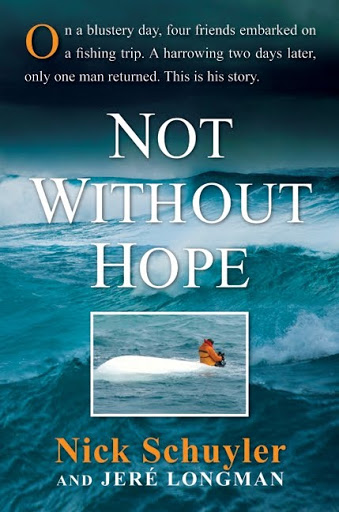
Not without Hope

I’m a slow reader. Very slow. I actually envy those who read quickly. I took a speed reading class in college and it just didn’t do the trick.

Yet every so often (like ever few years) I’ll pick up a book and finish it quicker than it takes me to mail something to Florida. Such was the case with this book: Not Without Hope. I alluded to the 4 boaters (all played either college or NFL) in my last sermon on Jonah 2, and then quickly ordered the book.

Not Without Hope chronicles their trip out 75 miles into the Gulf of Mexico, the bonehead decision that landed them in the water, and what happened while they waited for rescue. I didn’t find the book brilliantly written, but you could argue neither are Hemingway’s books. Yet Earnest Hemingway was brilliantly simple in his writing and so I guess, perhaps, that’s one of the reasons why I kept turning the pages. Conversational language along with a riveting survival story, and in the water. That’s my bag.

But again, reading a story in which you already know 3 out of 4 human beings die is tough. So I felt the dichotomy of excitement and sadness.

God is not absent in the story, according to Nick Shuyler, as the survivors cry out to God, and read the Lord’s prayer several times together. Schuyler, who describes himself as, “not as religious as Marquis and Corey,” regularly cries out for God’s help.

This was probably the hardest part to read. They all cried out to God, yet only one of them saw deliverance.

All of us, who are still alive, have cried out to God, and felt like He didn’t deliver us out of our situation. Or that He didn’t deliver us in a “timely” manner; for me the time is always “now” and God will often say, “not yet.” That’s actually one of the main reasons why the early Jews didn’t believe Jesus was the Messiah: he some things “right,” but didn’t do enough “now.”

Many saints (Christians) have cried out to God, and have not been delivered from their situation. But though they’ve left this world crying, they’ve entered into a new world laughing. Jesus often chooses to deliver us from death, but sometimes he delivers us directly to Himself via death.

So did He fall through on His promise in such cases? No. The good news for us is Romans 8:38: “neither death nor life, angels nor rulers…..sharks or drowning (GIV-Geoff’s International Translation) can separate us from the love of God in Christ Jesus our Lord.”

How he delivers us is up for grabs, His grabs. Where He delivers us is not. Take it not from me, but from one who the Lord delivered from many situations, and eventually delivered him straight to Himself via an early death: “The Lord will rescue me from every evil deed and bring me safely into his heavenly kingdom. To him be the glory forever and ever. Amen. (II Tim 4:18)”

Unknown's avatar

Lesson from March Madness

I don’t know how many years I’ve filled out NCAA tournament brackets in hopes of guessing enough of the winners correctly to win some sort of prize. Maybe cash, maybe pride. I’m not sure if I’ve ever really won, except for maybe once, but then my roommates bowed out of their obligation and Repo Men hadn’t come out yet-so I had no idea you could take out organs as payment.

This year 10 of us from Redeemer joined up to do an on-line tourney that tallies everything up. Its quite nifty, actually. The plus side of filling out brackets and having a winner is that we’re all (or at least that’s the plan) going out to eat after the tourney is over. Well, that and the fact that you have a vested interest in seeing teams like Southwestern Wisconsin Tech vs. North Georgia Weslyean. Games that you would otherwise not care about become something special.

But there is a problem with filling out brackets and putting your hope in something of which you have absolutely control over: upsets. When you don’t pick an upset, like a 15 Robert Morris over 2 Villanova (which almost happened) or 14 Ohio University over 3 Georgetown (which did happen and eliminated one of my Elite 8 picks), you get, well, upset.

Instead of celebrating a “cinderella” type story like Ohio, you pull against it. Instead of seeing the beauty of an upset, against-all-odds-type story, you pull for the boring, standard outcome. Simply because that is the way you planned it.

It reminds me of life. There are probably a lot of beautiful “upsets” in life which I fail to rejoice in because the normal, boring, safe and expected outcome which I “picked,” doesn’t happen. But as I think about it, if life is only vanilla, and the outcome is only as expected, then I’d not experience the beauty of the cinderella-type upsets where God comes through against all odds.

Unknown's avatar

On taking lampstands

Our senior pastor Barret Jordan has been going through Revelation, and spending a good bit of time on the first several chapters. I think this is a wise approach, because most interpretive grids often forget these early chapters as a reason WHY the book was written.

On a side note, The Millenial Maze is a book which graciously, not angrily, dogmatically, or presumptuously, deals with the different ways of interpreting Revelation’s end times scenarios.

Anyhow, Barret encouraged the congregation to consider what it means, “….to have abandoned the love you had at first (Rev 2:5).” There are several clues to exactly what it means to have “abandoned the love,” and you can hear Barret’s exposition here. His conclusion was that “abandoning the love” referred to a church’s inward turning, where it stops being a light to the community.

The result of “abandoning the love” is something that is perspicuous and not debatable: Jesus says “I will come to you and remove your lampstand from its place, unless you repent.” (Rev 2:5)

That’s pretty straightforward.

And we cannot deny that Jesus has done this throughout history. Churches will open and then they will close. Exactly what leads to their closing may not be something any onlooker or member can with certainty pinpoint. However, we should all realize Jesus is not afraid to shut down a church when it abandons it’s first love and ceases to be a city on a hill.

This happens cross-denominationally. I’ve seen it happen in both presbyteries I’ve served in, and I know it will continue to happen. And Barret reminded us that it could and will happen here at Redeemer, should we choose to squabble amongst ourselves and ignore our community.

The takhomasak (to be Steak-N-Shakean) application from this sermon, and from this passage is to regularly repent of ignoring the community. Nowhere does Jesus promise that an individual church will last forever.

But this is also somewhat encouraging. It shouldn’t do anything to our faith when we see church’s close their doors. Jesus says it will happen. But his church universal will not fail to move forward, even when numbers of local churches will come and go. Jesus will build His church, and He will always have some sort of lampstand around until He returns.

So when we see churches-in the past tense-like this one off I-64 in WV, we can both repent and relax.

You can click here if you want to here his sermon.

Unknown's avatar

Callipari and unselfish coaching

I heard a snippet of an interview on the Dan Patrick show yesterday. In the interview, Dan Patrick poked and prodded in reference to a previous interview where Kentucky coach John Callipari said he would “wrestle John Wall (his starting point guard) to the ground if he decided to return and play for him the following season.”

John Wall is projected to be the number one pick in the NBA draft this year. He’s also a freshmen. So why stay in school, when the only thing you can do is hurt yourself: either by actually getting hurt, or by hurting your draft stock-the only place to go is down.

Callipari gave his reasoning behind “wrestling” on the most recent interview and it went something like this: “I don’t need him to build my coaching credentials, to get more wins for the program, to make me look better. I want him to do what’s in his best interest, not my best interest.”

Now we pastors don’t have to worry about anyone getting “drafted.” Outside of Enoch (Gen 5:24) and Elijah (II Kings 2:11) who got “drafted” into heaven before death, I don’t think Jesus is going to do that again until He returns (I Thess 4:16-17) and finishes His Kingdom work of making all things new (and not before then).

Nevertheless we as pastors, and we who are involved in the local church will experience people moving to find work, get promotions, be near or take care of ailing family, or retire. This is hard, especially when our “starting point guards” decide it is time to move.

But I think Callipari, reminds us all to consider the good of the “player” and the good that the “player” may do by moving elsewhere. Even if it is hard for the local congregation. And it has been hard for me over the years.

Unknown's avatar

The other good Reverend Doctor….

I don’t know a whole lot about Dr. Martin Lloyd-Jones, but I have a few of his commentaries, and know enough to know that I should know more about this lad. That might have made sense. Here’s a short video biography, should you be interested. Sounds like an awesome guy.

My only beef with the video was the narrator’s approval of preaching without any mention of current events, humor, or anecdotes. Now in a time where the main goal of a worship service has often shifted to entertainment and emotion, this might be a helpful reminder.

However, when preaching God’s Word, I think it is always a good idea to illustrate. Jesus used illustrations/allusions in his ministry, and not only in his illustrative parables (vine and branches, living water). And it was His idea that the prophets regularly illustrated their points with object lessons. Ezekiel had to lay on his side for 390 days and prepare bread made over cow patties. How’s that for a children’s object lesson!

The Puritans also illustrated their material-fortunately because they are not always the easiest to read. But I benefited from Jeremiah Burroughs illustrations in The Rare Jewel of Christian Contentment. The illustrations were quite helpful in understanding and application.

Why shouldn’t illustrations/allusions/stories where God has done amazing work, be part of the preached word? Especially when such were so prevalent in God’s Word and His Church over the generations.

Unknown's avatar

Sometimes saved not from, but in your situation

After an elder recommend it to me when I first ascended the mountainous region of West Virginia, and stayed with him, I began reading Don Kistler’s work A Spectacle Unto God. Yet I hadn’t picked it up in quite a while. Now after reading some this morning, I’m now going to be finishing it soon (its a short book).

The book alternates chapters filled with biography and letters sent/received during Love’s stay in the Tower of London. Thus Kistler does a good job of not simply telling a story, but encompasses all perspectives: the Normative (the standard of truth-Scripture; HEAD) the Situational (what’s happening in life and the world; HANDS) and Existential (experiential or HEART) perspectives. For more info on the multi-perspective stuff, click here.

Anyhow, sometimes I wonder what it really looks like in life when folks say, “The times were tough, but the Lord was totally with me.” I mean, sometimes God doesn’t deliver us from our situation. Nevertheless, existentially, he does deliver us from being enslaved to our situation. This truth is what Christopher Love, in essence, wrote and expressed to his wife:

…for he said himself that he did never know what it was to have full assurance of faith till he had received that sentence of death at the bar, and at that very minute he said to his wife that, “God came in with such ravishing manifestations of love upon my soul that I feared it was to discovered in my countenance and may be so interpreted if I smiled in a contemptuous way upon my judges.” pg 71

Unknown's avatar

Dangerous place to teach

Teaching in the ghetto can be dangerous. Of course, you can go to the opposite end of the spectrum and go to Alaska. Unfortunately, that might not necessarily be the safest place to teach either. Check out this sad story about a teacher apparently attacked by wolves.
Kind of reminds me of the movie Twilight where the town folk didn’t know what kept mauling its residents. But as far as I know, that movie is not “based on” or “inspired by” a true story. Still, creepy.

Unknown's avatar

The beauty and difficulty of a taste of spring

I’ve been loving the Spring weather we’ve been having up here in WV. I think its even supposed to get up to the mid 70’s today.

Unfortunately it will get a bit colder and rainier for the weekend. And I’m sure there are a few more cold fronts to come, so it wouldn’t surprise me if we got some more snow. In some ways, this warming trend has been incredibly helpful to me personally: I can once again wear flip-flops and Connar can play outside.

On the other hand, this taste of spring makes me yearn for more of spring. So when that taste of spring meets up with my experience of winter, this can also be quite difficult. I mean if another arctic cold front comes through, it will probably feel worse in some ways since I know exactly what I’m missing.

This spring fever parallels the experience of the Christian. We get a little taste of heaven throughout our Christian walk. Sometimes that taste comes through singing, hearing the Word preached, marital benefits, the brilliance of a piece of art, music, movie, or simply, the actual season of spring. But its a taste and not the whole thing.

So when we find ourselves fully satisfied with this world, that Jesus could just take his sweet old time returning and making all things new, we should be alerted that something is not right with us. After all, the penultimate verse of the bible is, “Come Lord Jesus, come. “

And when we find ourselves not fully satisfied in this world, we should be reminded that it is not because we “still haven’t found what we’re looking for,” but that as Bono later sang, “Yahweh, always pain before the child is born.”

In conclusion, Christians get a taste of heaven which satisfies us along the journey, but that satisfaction will not be complete THIS side of heaven. That taste will leave us longing for more.