Unknown's avatar

An Old Puritan Formula


A few weeks ago, our session had a retreat. This weekend, our whole presbytery had a retreat. In the same place. It was a great time of being renewed in the gospel. There was nothing earth shattering as far as a new principles go, but simply getting back to the basics.

We followed an old Puritan model of spiritual renewal. First there is a downward aspect of repenting that simply has to take place. We were instructed to repent not simply of our specific sins, but why in fact we chose those sins. Sin is always rooted in disbelief in the gospel.

We stopped there for the evening and then moved on the next morning to the upward part: faith. We tried to isolate a certain aspect of the gospel, a certain accomplishment of Christ which we had previously failed to believe: and thus fell into sin. It was great. I had to really reflect on the fact that there is no condemnation in Christ, and therefore I do not need to be angry when I don’t see ‘the results’ (numbers) I would hope to see in the church. The ‘results’ don’t validate me: Christ does. So I’m trying to believe that.

Another thing that I learned was this: “you don’t have to go it alone” (U2). Solitude is not always a bad thing, but being in real community around folks who truly believe always helps me when I’m struggling. If struggling with doubt, I’ve found that surrounding myself with believers (fellowship) blesses my soul greatly and begins to chip away at my doubts or despair. A community trying to believe, share, and apply the gospel is truly a beautiful thing. Even more beautiful than an individual trying to do the same thing.
Unknown's avatar

True Faced

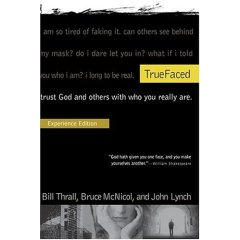
A former seminary friend (though fortunately he’s not a former friend) and youth pastor in our presbytery recommended a book to me called TrueFaced. Since its co-written by John Lynch (I know its not the football player, but like George Costanza, I still think its cool), I quickly ordered it off amazon.com.

The gist of the book is that our justification before God ought to make us be more open, honest, and real people before Him and others. I’ve enjoyed it so far, and am about 2/3 of the way in. And I recommend it you, understanding that if the last third is repulsive I may recant.

In a particular part of the book, Lynch and his men contend that we ought to be willing to trust others more deeply without the constant fear of them letting us down. We are to let others love us despite their imperfect attempts. But he does so in a way that doesn’t allow relationships to become idols.

“Will others meet our needs perfectly and will we trust perfectly?
No. This is the Room of Grace, remember? Grace is the face
love wears when it meets imperfection
.”

I love that sentence. Maybe it’s the wording. Maybe it’s the concept. Maybe it’s both. We are constantly dealing with people who are imperfect, who are not trustworthy. So as soon as you or I commit to love another, it automatically must become gracious (independent of their deserving it), or it won’t be a commitment for very long. And I guess it wouldn’t have been love either.

This doesn’t exclude the need for ‘tough love’ of course or the need to call people to repentance. Instead it is a good reminder to me that love and manipulation really have nothing to do with one another. And yet my ‘love’ is often manipulative-based upon what you bring to ‘my ball club.’ So I guess I need Jesus to work on my “Grace Face.”

Unknown's avatar

An Angry Bovine Evening

Last night I wanted ice cream. And when I want ice cream, there is only one solution: go and get ice cream. So we headed to the Mad Cow Creamery (actually its the Big Cow, but we call it Mad Cow because that’s what I would call it if I owned an ice cream store).

When Amy and I got there, we noticed our neighbor (who didn’t remember meeting me a while ago) and so reintroduced ourselves. His son, the owner of the shop, was preparing an traditional Indian birthday carrot cake-like concoction. It read “Happy Birthday Krishna.”

The father was heading to some sort of birthday party for Krishna, who is one of “the main gods” in Hinduism. The party was slated for midnight because that was Krishna’s time of birth. We know Jesus was born sometime in between 4-6 BC, but the Hindu’s somehow know the very time!

Anyhow, Krishna was born a man, but later became deity upon death. I guess that’s what prompted my neighbor to say that he was “like Jesus Christ.” Of course one difference (besides reality), is that Jesus was the preexistent creator through whom the world was made (Col 1), who in the fullness of time took on a body (Gal 4:4). Kind of different order.

Anyhow I remembered some of this from my World Religion classes, but the store owner filled me in on the rest. Simply by asking some questions about Krishna, I was able to show respect to someone I obviously disagreed with. And he certainly was glad I showed some interest in his culture and religion.

But who knows, maybe that was a start to a relationship where the gospel can be fleshed out and expressed one day. Who knows? But at the very least, I think I can now get my neighbor to come to a neighborhood cook out. And I’m even more certain Amy and I will now be getting a friendly wave back instead of a “why-are-you-waving-at-me-type-stare” we’d been accustomed to.

Unknown's avatar

Are you worth it?

I did something rare yesterday; I saw a movie in the real theater. A matinee of course, though. Fortunately Transformers was still out, so I could take advantage of the high quality sound systems in ‘real theaters’ (the dollar theater has decent visual, but bad audio-but for chic flicks, the audio isn’t as important, I’ve found).

The movie was quite delightful, if you can use such a word for a movie whose plot centers around alien robots battling each other for a ‘cube’ which can turn blow dryers into robot warriors. But it really was a good story, with great action sequences, and some cleverly written dialog. Seriously.

One theme which periodically popped up was the goodness of humanity. The Darth Vader of Robots (Megatron) questions why it is that another robot would be willing to sacrifice himself for humans. After all, humans were quite inferior and were incredibly selfish and destructive. We can all agree with the latter two, but honestly, I’ve never met a robot I’ve felt inferior to. Maybe that’s just me.

Optimus Prime, the Luke Skywalker of the Robots, noted that the humans really hadn’t been around all that long. Give them some time, they have some good traits. They are in essence good, and just need to work some kinks out (a modernistic worldview of humanity). There were several other exchanges which reinforced the goodness of humanity-a theme, or at least a hope, that I’m seeing in news reporting and more and more in pop culture.

I really don’t think that I’m on one of those communist witch hunts to see this stuff. But if I am, I repent and want to remind you that I’m neither a communist nor a witch.

But when I see the goodness of humanity expressed on the big screen, or more importantly the big screen of our culture, or even more important than that, the big screen of our hearts, I see one big enemy of the gospel. And it breaks my heart. For the gospel actually affirms more greatly the dignity of man than any other modern/humanistic worldview.

Christ didn’t die to ‘work out the kinks,’ but to provide salvation and hope for a people devoid and unworthy of such hope. However by his sacrifice, Christ affirms to the the world that while we are not worthy to be saved, we are still ‘worth’ saving. That’s far more dignity than our buddy Optimus would confer upon humanity (although let’s not blame Optimus, he’s just reading his lines).

That’s some serious dignity, and humanity truly does long for dignity. But it only comes if we can first ‘eject’ our notion of a latent goodness in humanity. And instead embrace the goodness of Christ, who is the hope and Savior of humanity.

Unknown's avatar

Labor Day

Someone at youth group last night asked a question probably many of us lie awake thinking about, “What is Labor Day for?” And it is a good question indeed, though it often goes unasked by most folks, and therefore unanswered. And since no question is a ‘dumb’ question (at least that’s what good teachers tell shy unconfident young question askers), we’ll delve briefly into what Labor Day really is.

Some McGuire, either Matthew or Peter-no one knows for sure-came up with the holiday in the late 1800’s. Regardless of which McGuire came up with it, Labor day was created by the Central Labor Union and a parade soon ensued. Just two years later in 1884, many other industrial centers thought “we can do better than a parade.” Thus they so solidified Labor Day’s place in September.

It was to be a “working-men’s” holiday to celebrate those “who from rude nature have delved and carved all the grandeur we behold (Peter McGuire).”

Since I’m not a Jehovah’s Witness, I can celebrate holidays, and can do a lot of other cool things with the freedom I possess in Christ. How then should I celebrate Labor Day? Well last year, I painted my office room blue, and this year I went fishing and watched Transformers. But I think there is a bit more that can be done, but of course no parades for me.

I’m not in a union, and am not being paid by a union to say this, but I think something related to Labor Day is worthy of reflection. There are a lot of jobs which are completely thankless, and for which I have neither the skill, desire, or tolerance to do. Collecting garbage is certainly up there. But this is an important thing to do, and we ought to be thankful that folks do it. What about toll booth operators? How hard would that be? Recently they’ve been really darn friendly to me (so I’m kind of ‘high’ on them right now), and are doing something that simply needs to be done.

But jobs like these might run the gamut, from blue to white to ring-around-the-collar.
So in honor of Labor Day, or rather just to honor one another, (which is a scriptural command from Romans 12 “Be devoted to one another in brotherly love. Honor one another above yourselves”), thank the un-thanked. Or at least honor them by remembering what they do. I think they’ll thank you right back.

Unknown's avatar

Deep reflection


Randy and I made the trip to the Apple store early this morning in hopes of getting my darn Ipod to sync with my computer. Well, the trip to Tampa proved to be a futile attempt to bring an Ipod and its coolness into my life. The tech dude hadn’t used Windows stuff since 98, so he couldn’t do much more than I could. That was information that would have been helfpul if brought to my attention yesterday. Nevertheless, it was good to have someone to whom I could talk and discuss hard life decisions.

But in reflection, after numerous attempts to get this thing to work, maybe the Ipod (for me) is like that girl you wished you could date, but she wouldn’t give you the time of day, or just wanted to be friends (even worse!). And to pursue her any longer would be tantamount to stalking. Am I a stalker? I don’t want to be that guy.

Maybe the Ipod isn’t ‘meant to be’ for this time in my life….Or maybe this is a sign to get a new computer after 5 years of Toshiba excellence…..Maybe I can see some ‘writing’ on the wall, but I just can’t read it yet. Maybe.

Unknown's avatar

Microsoft Excel in Grace

I’ve been reading II Corinthians for my morning devotions the past month or so. Today I came across a puzzling passage: “But as you excel in everything-in faith, in speech, in knowledge, in all earnestness, and in our love for you-see that you excel in this act of grace also” (8:7).

The question I raise is “How does someone ‘excel’ in an ‘act of grace’ when Paul begins the passage by explaining that the grace God has given the churches in Macedonia has moved them to give, and even in the toughest situations? I mean if grace is given, then how can someone excel in it?

At first look it sounds like a contradiction. But I think I might at first glance have been falsely dichotomizing two truths. God gives grace and this grace is responsible for any good work in the life of a Christian. Yet we must respond to this grace. Westminster Shorter Catechism question 35 defines sanctification as “the work of God’s free grace,(1) whereby we are renewed in the whole man after the image of God,(2) and are enabled more and more to die unto sin, and live unto righteousness.”

God works in us= grace. Because God works in us to will and work for His good pleasure (Phil 2:13), then we do live out our salvation (Phil 2:12). In other words we are enabled by his grace to lay aside our own innate selfishness and follow Jesus more nearly. In order to “excel in this grace” we are then to regularly respond to the grace given to us.

How might we regularly respond? Jesus told the disciples to freely give as they have received. In order to ‘excel in this grace’ I imagine we would need to actively realize how much we have been given, and actively repent from our own love of money. Of course, who works that repentance in our lives? God in His grace. Fortunately we can pray for a repentant heart.

Did Paul’s exemplary church in Macedonia excel in this grace because they simply had ‘more grace?’ I don’t know (I really don’t know what that means anyway). But one thing I do know is that a lack of response to God’s grace is never blamed on the fact that God didn’t ‘give’ enough grace. Giving is a spiritual gift-and some are more giving than others.

But a lack of excelling in this grace is more probably due to a lack of reflection and belief in that grace. At least for me. So probably I can’t use that excuse when challenged to give!

Unknown's avatar

I’m tired of three’s


I’ve been making some bad purchases lately. Although I don’t know if I’m worthy of all the blame-certainly not most of it. Now I did buy an awfully made kayak fairly whimsically the other day. However I learned my lesson, did some research, and bought a more expensive kayak which had come well recommended. The only problem with that one was that it leaked. Kind of important for a boat not to leak. Kind of. So I took that one back and bought a third. I should be keeping that one.

Next came the weed whacker. This time I waited for a recommendation: go Electric. So I did, but the spool kept coming off on my first run through. So back to the drawing board. I needed to go Black & Decker said so and so. I did, and when I opened up the box to put it together-alas, behold, or whatever other word you would say-there was no spool or cover at all.

So I took that back today during my lunch break and got the same kind. This time the Lowe’s guy opened it up just to make sure. It was there. At least I didn’t buy the recalled model.

Well now my Ipod (which I thought was going to be like “A whole new world” for me, some sort of “dazzling place I’ve never been”) won’t sync. My kayak would sink, but my Ipod won’t sync. A cruel irony. An Ipod that won’t sync is like a boat that does sink: worthless. So I’ll be driving to the Apple store to see if they can ‘sync it up.’ If this three part sequence continues, I should only have to drive to Tampa or return the Ipod one more time after this Friday. But I’m hoping to break the sequence. More of a curse really. Hope you don’t get struck by the Terrible Threes.

Unknown's avatar

A Hell of a Good Time

I DVR’d a hellish Dateline special about a month and a half ago, and finally got around to watching it last night. The subject matter was Hell.

Different people offered viewpoints, from a charismatic preacher, to a Oral Roberts grad turned liberal, to your friend and mine Marilyn Manson, to a torture victim. Manson believes hell and heaven are simply two ways of explaining the dual nature of man (good/bad). “Its that simple.” Some believed that we’ve created hell on Earth, while others emphasized that everyone goes to heaven.

They allowed everyone from Satanists to evangelicals to speak, and did a fine job representing each party. Here are two things I found worthy of a second look.

First of all, the narrator explained how the former Oral Roberts pentecostal mega-church preacher made his shift to universalism. First he began to see the bible as simply a book about God, written by men. Then came study in original languages, followed by the notion, “I just don’t see how a God of mercy could……” He still obviously believes in God, and so asked Him, “Am I doing the right thing in leading people down this path?” God gave him the green light. Of course, without the aid of scripture, God can ‘say’ a lot of crazy things, and justify a lot of stuff. But the special was beneficial in showing how his metamorphosis all began.

Secondly, a woman who had been tortured by some S. American government, expressed that her only hope in life was that the goodness of humanity would triumph over the evil of it. If humanity weren’t in essence good, then she would just give up now. There could then be no hope outside of this truth; it would have ‘destroyed her sweater’, pulling the proverbial thread as she walked away (hope you enjoyed the Weezer flashback).

Concentration camp survivor Ellie Wiesel expressed similar sentiments. Perhaps that was the agenda of the show? I’ve recently noticed through several mediums (sports talk, TV) a need for people to reestablish, or personally re-believe in the goodness of humanity. Although this is really anti-post modern, and I thought we were passed that.

Do you encounter people ‘pimping’ the goodness of humanity? Let me know. It is definitely a bridge to the gospel, but just a different one than I would expect to use. Maybe I shouldn’t expect.

Unknown's avatar

Disagreeing with a King


Well, Michael Vick did what anyone would do when facing federal charges, with clear evidence and people willing to testify against him: he pleaded guilty to dog fighting.

And so this story has captured the sports world. Most of the shows and segments on those shows, dealt with the question: where do we go from here? I found one particular segment on “Cold Pizza” quite fascinating. Former Bucs QB Shaun King participated in the discussion and made some fairly bold statements. Apparently Michael Vick didn’t “owe anyone an apology.”

This ‘anyone’ did not include, of course, “The Lord.” Vick needed to seek forgiveness from God, but really didn’t need to apologize to the people he let down (like the fans and his teammates) as well as the commissioner (who he blatantly lied to). His public apology today went a step further in showing his contrition, and proving his forgiveness. These apologies weren’t superfluous, but they were not required. He only needed forgiveness from God, and he had that.

I love Shaun King, I really do. Not only because he was a classy Bucs QB (who’s job was simply taken away from him), but he is a brother in Christ. And he is very bold with his faith, and I love that. And his point is made that there is forgiveness in Christ. With that being said, I’d like to examine what he said.

Does Michael Vick ‘owe’ an apology to the fans of Atlanta, and his teammates? His poor decision making not only hurt himself, but also hurt the Falcon’s chances (which I’m glad for by the way). But then again, maybe Joey Harrington is the answer there? An apology might not be required, but it certainly seems like there was a lack of concern for others.

Does Michael Vick ‘owe’ an apology to the commissioner (whom he lied to face to face), and to all those he lied to when he professed his innocence via a statement? Certainly we are forgiven even though we can’t go back and tell the truth to all those who we’ve been dishonest or lied to over the years. That is not a prerequisite for forgiveness.

But how can there be reconciliation without apologies for wrong done to one another? Certainly sins can only be forgiven by God through the work of Christ. But the fruit of forgiveness in a believer’s heart is expressed through apologizing to the offended party.

Psalm 51 does show David saying that he sinned only against the Lord. Perhaps this is King’s thinking. But is this a correct application? Clearly people do sin against one another. In James 5, we are instructed to confess sins to one another (although very few Christians think James is serious in much of what he says) , and Jesus instructs us to even seek out those who might have something against us. Perhaps we have sinned against them, and an apology is what he has in mind?

I still think that if Uriah weren’t killed in battle, David would have ‘owed’ him an apology for sleeping with his wife. So while Shaun King is by far my favorite ‘King,’ I will respectfully disagree with my Buccaneer brother in Christ.