Unknown's avatar

Corinth: The Tampa Bay Bucs of ancient churches

Image

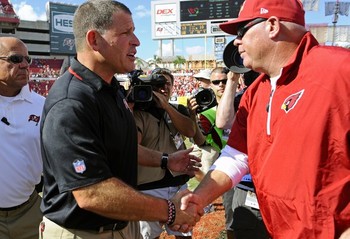
If you haven’t followed the Bucs this year as a fan, consider yourselves, “lucky,” or perhaps a more Calvinistic expression is apropos: “Providentially blessed.” It’s an absolute circus. A tough and reasonably (people have good reasons) disliked coach named Greg Schiano, who actually was featured in the Sports Spectrum magazine volume which I wrote devotionals for a number of years back. So yes, as much as I want the guy fired, and really don’t see the same Christian character we saw in Dungy, we will be forever linked together in the minds of the vast Sports Spectrum readership across the globe. A quarterback, once considered good for a season, has recently found himself out of the picture. Literally, he overslept and missed the team picture and has now been relegated to watching the game in the “inactive” suite. As we speak he is in stage 1 of some substance abuse program, because in his words, he tested positive for riddalin when he only had a prescription for Aderall. Maybe someone confuses Tylenol for Advil, but that sounds to me a bit silly and missing a bit of info if not truth.

The team has lost 3 games by 3 points or less, one on a penalty, another on missed field goal, and the third because of Napoleon Quarterback’s bonehead interception at the end of the game. I guess things could get worse, and probably will. The Lions 0-16 team will be watching anxiously for this team to descend to such a level.

As much as I want to rid myself of all Buccaneers’ association, I just can’t. They are a mess, but I’m still connected to them because they are my team. They are in some sense my mess, because I live in the area.

The church in Corinth was a mess. It was the Tampa Bay Bucs of churches. Bad, probably Schiano style micro-managing leadership. Locker room factions saying, “I follow Paul, I follow Apollos.” Then the super spiritual, overly proud non-denominational guy, said, “I follow Jesus.” People sleeping with in-laws. “Super-apostles” comparing themselves with Paul and finding themselves better, and then getting people to follow? Folks thinking that their gifts were better than the giftings of others. Dudes getting drunk at communion and then eventually “falling asleep,” and I’m not talking about passing out.

Yet, in all of the mess and dysfunction caused by sin, Paul has the chutzpah-I guess you could call it that-to address these jokers as “saints.”

To the church of God that is in Corinth, to those sanctified in Christ Jesus, called to be saints together with all those who in every place call upon the name of our Lord Jesus Christ, both their Lord and ours (I Cor 1:2)

Jesus must have done something to make the Tampa Bay Bucs of ancient churches “saints.” They were saints not based upon what they did (duh!!!) but what Jesus did for them. He purchased and washed the church with His blood, and He is the one who declares her righteous. Of course the church washed and purchased, has also been redeemed from slavery. But just like a bunch of convicts set free, we’ll soon make a mess of the good He’s made for us. Unaddressed sinful patterns don’t change overnight, despite the fact we’re no longer enslaved to them. Yet he will take the mess and make something good. Jesus takes greedy people and makes them generous. He moves sexually immoral people toward repentance and restoration. He takes skeptical folks and increases their faith. He did this in middle of this mess. There were bright spots too: evidence of Jesus work in the mess.

You can give up on the Bucs. But don’t give up on Jesus’ church, more specifically its manifestation in a local body of believers. Jesus didn’t, and he still doesn’t. It has always been a mess, but in Jesus eyes, it is a “hot mess” and we’ll eventually see what we’ll become. Until then, keep taking a sneak peak at Revelation 21 where the church comes down from heaven as a bride adorned for her husband. Hot, but no longer a mess.

Unknown's avatar

Shortcomings of cliches

I’ve been slowly working my way through Matthew Lee Anderson’s  The End of Our Exploration. I must admit that this is a thoughtful book, though at times, I find myself appreciating but not fully understanding his rhetoric. He’s quite the wordsmith. Yet just this morning I came across some some very helpful sentences on cliches.

Legalism is still in our midst, but the greater the intellectual danger is from a rampant reduction of the faith to banal cliches. “Let go and let God.” “God will work it out.” “It’s a God thing.” “Everything happens for a reason.” “It is what it is….” Cliches stop thought prematurely. They are a retreat from the hazards of thinking; we run from the unknown to the comfortability of platitudes.

I’m sure I use cliches, but that doesn’t mean I can’t stand them. I am especially averse to the “It is what it is,” which my realtor in WV used over and over when each deal would fall through.

I think Anderson really nails it here:

One of my “favorite” cliches is that we “shouldn’t put God in a box.” That may be true on one level. But what if God has put Himself in a Scripture-shaped box? What then? Is the problem the box or the shape?….If we say “God doesn’t judge,” does that put God in a box? If God isn’t in a box, even a Jesus shaped box, can we know Him? Does God know He lacks a box? Is He able to communicate to His creatures the shape of a box he could fit in….?….. I don’t know the answers, but I do know the cliche short-circuits the process of finding them. 

Some cliches, like “it is what it is” are distinctly non-Christian and stem from Stoic philosophers. Others are have a bit of Christian truth (remember, often heresies are in essence “half-truths”) and become that much more dangerous because they sound pretty good.

I would love to be able to spit out Anderson’s paragraph any time I hear that cliche, but would be fortunate enough to remember a single sentence. Still, the question I think is worth a thousand words is, “What if God has put Himself in a scripture sized box?” If I say I am a Bucs fan, and you truly believe that, I have just intentionally placed myself inside of a box so that you can know something about me. I haven’t told you  that I’m not pleased with there 0-4 start, but if you listen to what I’ve already told you, you know something about how I feel when they lose. But you also would need to know that other things are more important to me than the Bucs. I’ve just put another corner on the “box” so that you know can know more about how I actually feel. You can’t know anyone without some sort of a box.

Cliches don’t just short-circuit learning but they short-circuit counseling and comfort. That’s another reason why we use them. Some expressions can become cliches, but some just never will, because they possess a latent question within them.

Such is “I’m sorry.” Saying “I’m sorry,” has a question embedded within it. It says, “I don’t know exactly why this had to happen, and I don’t know what God will do with this, and with you.” But it escapes the “it is what it is” cliche which tells us to not to question, learn, seek, react, respond, become angry.  “I’m sorry,” leaves room for questioning, both from the recipient and the one offering a brief two word counsel. Yet the Christian has a home base from which to question. Such words as “I’m sorry” go beyond the cliche to open the door to a healthy scripture framed questioning. God has given us “sides to the box,” so we can know something. We can and should question, but we don’t question without hope.

Unknown's avatar

Church planting could be the best thing for your kids

kids

Planting a church is a privilege as well as a huge challenge. As I’m in the gathering stage right now, from time to time, I come across “the children barrier” in folks who might be otherwise interested in coming alongside such a risky venture. Even though some people may be excited about the vision, the problem may lie within the realm of this question: “what about the children?”  Christian parents, and probably even those with a merely moral framework, are concerned about their children being taught, or at the very least entertained, well. And the latter is a good concern.

I guess you could say, I believe the late Whitney Houston. Children in some ways are the future (the present too), so “teach them well and let them lead the way.” But how and where we teach them is also quite important. So is the “what! I really do think these are good questions to ask but I don’t think answering them the way they have been answered in the past 50 years is necessarily the best way to go forward.

I don’t think leaving to form a core group is detrimental for the child’s growth. In fact, I think, it could be much the opposite with some intentionality. Of course this isn’t only an issue with church planters, but for established churches where folks sometimes bolt for a “better” children/youth ministry.

Here are some things I’ve been mulling over in my head. Hopefully they make a little sense.

1.) Many people don’t recognize that the primary place for children’s Christian Education is in the home. Now of course, vital children’s ministries can and should assist parents. And I realize some parents just don’t take responsibility, so a vital children’s ministry is all that some kids get. God is faithful. Nevertheless, if a parent takes the time to disciple his/her children, the child will more often than not grow in his/her faith. Parents + Children’s Ministry + Adult Interaction/Service is not a secret formula but it seems to me more of God’s design for producing young disciples.

2.) If vital children’s/youth ministries were all that were needed, then we would see large percentages of kids connecting to a church when they leave for college. We don’t. The formula of solely running the kids through the grid of activities just doesn’t work. We Christians are a bit slow to recognize thing sometimes. So the lack of a vital children’s/youth ministry at the start-up of a new church will not stunt the growth of our children.

3.) Eventually, as the church gets “up and running,” children’s and youth ministries may take off. And parents then have the opportunity to play a part in their formation. This is one of the “fun” parts of starting new churches. It might just be a short matter of time before such ministries can supplement what you are already doing at home.

4.) Not everyone, and you could argue, not most people are called to form a core group to start a new church. But for those that do, here’s something to think about. Is it possible that leaving behind an existing church to form a new one could actually be a catalyst for growth in your children’s faith? One church planter’s daughter actually asked her Dad, “What’s that building?” It was a church. She just knew the church was God’s people gathered together. It was God’s people, not a building. Can’t put a price tag on that! For us, who left behind a great children’s ministry, we’ve seen our five year old’s faith grow.  We’ve walked around the block before and prayed with the kids that we would meet some new neighbors. When a church plant doesn’t have people or property, you simply have to ask God for just about everything. Things we never asked God for, we now have the opportunity to ask God for with our children. Don’t think that asking God for such things alongside of your children won’t have a big impact in their lives. Not only that, but we regularly teach our five year old that we are starting this church because many folks don’t know Jesus or have a church in this area. Teaching in the context of dreaming and doing.

5.) Before church plants can have fully developed ministries, existing churches can and do play a big role. Other churches may have children’s ministries that are fairly affective because they have the volunteers, the practice, and the facilities. I know of one which assists many parents in the area, yet many of those parents go to different churches. In the same way, such a church can partner and make the church planting process a bit smoother when folks desire such ministries. This may work for a season until something is up and running, or it may just continue to be a valuable asset for years.

In the end, starting a new church, because (not in spite of) it is such a faith stretching endeavor, is full of opportunities for your children to grow in their faith. Being a part of a core group is not for everyone. Please hear me say that. But for those whom God has called to join Him in a specific new work, it could end up actually being the best thing for your children. I’ve seen this time and time again with folks who’ve planted before me.

Unknown's avatar

Walter White’s Worldly Sorrow

Breaking Bad season 5, the final season, is soon to be over. I’ve said before that I’ve never appreciated a show as much as this one, and the final season hasn’t disappointed. If you’re playing catch-up, there is no spoiler alert here, just a common theme: Walt’s worldly sorrow. 

Throughout the show, despite the continual hardening of his heart toward anything “good,” he never stops displaying emotion. He’s not a sociopath. He does have feelings. Yes at times he does things unthinkable, but there are other episodes where we see real tears running down his face. Even in this last season, despite his malfeasance and machinations, he still cries. 

While Paul wouldn’t deny there are different types of tears, he classifies two major types of “sad tears.”

As it is, I rejoice, not because you were grieved, but because you were grieved into repenting. For you felt a godly grief, so that you suffered no loss through us. For godly grief produces a repentance that leads to salvation without regret, whereas worldly grief produces death. (II Cor 7:9-10)

We see Walt shed many a tear over what he has done: lives he’s either altered for worse or destroyed. But not long after those tears, we see him get right back after it. Nothing changes. There is sadness for a time, and perhaps even for a season, but this sorrow only leads to death: the ultimate separation from God. But we see glimpses of this descent into death through alienation with his family, extended family, his conscience, and his partner-in-crime Jesse. In the book of Jonah, every step he takes away from God’s commands is a step toward the place of death and separation, known as “Sheol.” Every step away from God is a step away from life. This is “worldly sorrow.”

When you see Walt’s tears, you think you see a glimmer of hope. And then you remember the name of the show is Breaking Bad. Just about everyone gets worse. People left to themselves will often show some signs of remorse, but will only display worldly sorrow. And we are reminded in this scripture passage, this type of sorrow only leads to death. 

If you are a Christian, you are not a Walt. You have definitively passed from death to life and that life starts now. While sanctification is definitive, it is also progressive (please don’t think Flo). The life you enter into is never devoid of struggle with the old Walt in us (or Adam to be theologically correct) who will inevitably seek to selfishly cry as a form of show, penance, or shallow regret. 

What’s the difference? If death is alienation from God, salvation is relationship with God first, His people next, and then what He’s doing in the world today. When Paul speaks of “salvation without regret,” he is speaking in terms of reconciliation. People have shown a sorrow that leads to repenting instead of running from God and His people. They have repented from their sins against God and Paul, and are now “back on good terms” with the latter. This type of godly sorrow moves you to deeper relationship with God and His people.

Repentance always has a destination, and that first stop is God. Then His people. Then becoming involved with how God in Christ (gospel preached through the gathered/scattered church) is undoing what the first Walt, or rather Adam, did.

Watching Walt’s worldly sorrow should lead me to a examine my sorrow to make sure it is truly leading me to repentance, which ultimately points me to the deepest experience of life.

Unknown's avatar

How much ya bench? Struggle spotting

After some time away from the gym, I’ve finally started getting back into the swing of things. It’s been a struggle but I think that I have found a time that works. Until the baby gets here and things, schedules, sleep, (life in general) changes yet again.

Regardless, my favorite exercise is the bench press. It is the most easily quantifiable, measurable, transferable exercise. I can tell, care, compare how strong I am, particularly in relation to others around me. Or in the NFL….Remember the SNL skit, “How much ya bench?”

I haven’t asked anyone to “spot me” yet, which is necessary if I’m ever going to actually get much stronger (not just back to what I could do in West Virginia). But I often hesitate even in asking people, because I don’t like having to tell people exactly how I want it done. Particularly when I don’t know them well. 

Sometimes when people “spot” you, they see you struggle and immediately put their hands under the bar. It then rises up very quickly. It goes from really hard to really easy. You don’t need to be a trainer to realize that muscles grow best when they are exhausted. They grow best when and only when there is a struggle. 

So when I get a “spotter” I have to tell him, “Let me struggle. Only help at the moment I absolutely need it. And then barely help it up.” 

When someone spots you and keeps you from struggling, it feels like you’ve just wasted your time. It’s easy, but you just won’t ever get much stronger.

I’ve heard the “faith is like a muscle” comparisons my whole life. But I’ve never really through the fact I actually seek such a spotter in the weight room. Such a spotter is loving. Such a spotter cares about me getting stronger more than he cares about easy lifting.

Yet such a spotter is there for a reason. I need him. I trust him. I have confidence he’ll let me struggle, but I also have confidence he won’t let me get pinned (that’s not much fun-there is no more helpless feeling in the world!).

Church planting is not easy. But neither is life for most people who aren’t church planting. Marriage, parenting, work, etc….Jesus is the spotter who seeks us out, but he does so because of His great love. I’m learning to see Jesus as a spotter and not get so mad at him when he lets me struggle. It’s not that he’s not there, but much the opposite. After all, that struggle is the best thing for me: conforming me to His image. That’s what He cares about most in the end anyway. When I begin to line up His vision for me with my vision for me, I’ll begin to appreciate his style of spotting a lot more.

Unknown's avatar

Cade, Goliath, and a Giant Penguin

I have two boys who love the bible stories. I have one who really loves one bible story more than any others. My almost three year old Cade can’t get enough of David vs Goliath. Most of the time, it’s the only one he wants to hear. He rehashes the story over and over. Of course, he pretends to be David (I guess that’s better on a number of levels than pretending to be Goliath). And I can see why. He’s a little guy for his age, and he, like all of us, wants to be the winner of the story. 

Last night Cade set up a giant stuffed animal penguin (though not quite as big as the penguin in Billy Madison), and pretended it was Goliath. He of course struck him down down dead. Thankfully he didn’t decapitate it, because that could have been costly as well as messy.

Cade’s impersonation is cute. Once again, he’s a little guy.

But when he gets older, would it be good to let him continue to think of himself as David? 

I don’t think so, and its not just because I’m an anal pastor type concerned primarily with theological precision. The reality is that most people exegete the passage the same way my three year old does. Most people find themselves to be David in this cosmic good/underdog vs evil/overdog saga of life. And its natural that we see ourselves as such. 

But let’s consider what’s really going on.

In Cade’s Toddler Bible he has begun to notice certain people. Who are those guys Daddy?

Those are the God’s people, scared to death.

No one can face this giant.

That picture tells much of the story. God’s army is on one side, the Phillistines are on the other side. One representative is needed. The Jesus Storybook Bible (the dialog of which Cade has basically memorized and recites when playing with his toys-its really pretty cute if I can say that) depicts Goliath looking to fight a representative of the people. If that representative will fight and beat him, the Phillistines will become subject to slavery. If that representative loses, the opposite will become true. 

The point of the story is not that you or I can rise up and be that brave person and beat our own personal demons, Goliath’s, or El Guapo’s in our lives for that matter. The point is that God HAD to send a representative, who would become King, who would do battle for us. If we are on this brave King’s side, then we are on the right side. That was the message to those who first read the story. Get on David’s side (Davidic line of kings). But of course, the story doesn’t end there. 

Jesus, the brave King, also born in Bethlehem, said “I will fight” for God’s people in order to deliver them. I will be their representative. I will not let this cup pass from me.

Our representative had his shot and blew it in the Garden (Romans 5). Yet Jesus does exactly what David did, but this time on a cosmic scale.


If we would begin to find ourselves as the army which was too scared and faithless to fight, we would begin to see Jesus more clearly in our lives. He is the one who fought for us while we were not only scared and faithless, but while we were yet enemies (Romans 5:8). Instead of trying to muster up the courage we may never have, it’s much more freeing to see how Jesus points us to David. And if that is so, we don’t stand up and lead a bunch of other people who simply can’t get their stuff together. We humbly get in line behind a conquering Savior and point people to Him. There’s plenty of adventure in following Jesus (a la Steven Curtis Chapman) because we can’t see the end of the story except through faith.
If Cade wants to dress up like David for Halloween, I’m OK with that. After all, my five year old already has some sense that David did “big sins” and Jesus is the real hero of the story. So it may not be too long….

But in the end, let’s not forget those scared Israelites waiting for someone to “step up” and deliver them. That’s us. Not a very glamorous start but the end sure is. 

Here’s a video of Cade Vs the Goliath Penguin

Unknown's avatar

Meeting church plant needs behind the scenes

One of the things I already knew, but has been confirmed to me over my short church planting life so far, is that you need a ton of people to plant a church. You really do. You need to have a number of folks praying for you. That much is clear and we looked at Jesus reminder to pray to the “Lord of the Harvest” for Him to send out workers during our first core group meeting (Matt 9:36-39). If you want to follow our updates and pray for us, click here. We also need to have a number of folks financially supporting our work; currently we have 30 individuals and 2 churches. If interested in giving, go here. Most obviously, we need to have people actually get involved in the core group meetings who will invite new faces. I already realized all of that stuff before.

But I was definitely ignorant of many of the roles I needed people to play. Here are a few:

Folks outside our core group connecting us to others: A dear friend of ours, who for the time being lives in Bradenton but will clearly never personally be involved in our church plant, has helped us connect with several young families. Who knows what will become of those relationships, but that is how this church is going to grow. I can’t meet enough people on my own through my neighborhood, fishing, gym, Tee-ball, Starbucks, etc. I try and I have met some folks from the aforementioned places, but I’ve realized how much help I really needed. And received.

Folks outside our area connecting us to others: I’ve had several pastors point me to contacts who live in the area. Neither of them live here, but they have sent me emails and phone numbers of people to call. Both of them are directing traffic from afar, and behind the scenes. Yet both have been playing a part that I just hadn’t really thought much about. I needed, still need, and have received such help.

Neighbors: I had a neighbor knock on my door on Sunday morning and let me know I could have people park cars in the neighboring driveway because no one would be home for several months (snowbirds). In addition, he told me he would ask about any possible meeting space in one of the rooms at his Catholic church. And after our core group meeting, one of my neighbors took a look at my on-again-off-again air conditioner. And is still doing so.

So in addition to giving, praying, meeting, there are many ways of participating in a church plant. While ignorant of such need right off the bat, I am no longer so! And I feel there are many needs, and people to meet them, whom I’ve yet to discover.

Unknown's avatar

Prayer: Are you talking to me?

A week ago, while worshiping at Cornerstone, I heard a succinct sermon on prayer from the Sermon on the Mount. It was quite a helpful little sermon that pointed out a few practical oft overlooked mechanics of prayer.

Length

Prayers in public don’t have to long. This is hard for Reformed folks. I think it might be hard for Charismatic folks as well. I think. Have you ever had a moment when you felt really “unspiritual?” Or I guess a better term might be simply “spiritually immature.” I’ve had a ton of them, so it wouldn’t be a great idea to rank them: not a great use of my time. But one in which would probably slide into my top 10 occurred after Sinclair Ferguson opened up his systematic theology class at 8 am with a 10 minute prayer. One guy came up to me and said, “Wow, how about that prayer. So…?” I filled in the blank with the obvious, “So long!” He replied, “No, so rich!”

I felt pretty low then. And perhaps I should have followed along better. But is longer necessarily better? The pastor indicated he thinks Jesus didn’t think so. When people have a lot to pray about, it’s hard to pack a ton in a public prayer. But remember longer isn’t better. Something to consider when praying with your kids or at your church. 

Which brings me to the next point he brought out.

“You talking to me?”

To whom are you talking in prayer? Or better yet, who do you want to hear you? Sometimes prayers can really be more like talking to people, as though they are your primary audience.

One of the ways you can know if you consider prayer as though you’re talking more to people, rather than to God, is how scared you are to pray in public. By public, I don’t mean 20 or more people. I’m talking groups of 3-4 folks. If prayer is talking to God, then it doesn’t matter how silly you sound to others. After all, prayer from God’s saints (all Christians) is like a redolent fragrance. Like corporate singing, it is not the sound of the words, but from whence the words come: the contrite, yet joyful heart.

Many of us at various times have forgotten who our primary audience really is. I did too when in seminary, as I rarely volunteered to pray in front of a large number of future pastors. We’ve all forgotten this timely truth from time to time.

But when we are praying in a group, is it really only talking to God, as though it doesn’t matter if people around you are listening? I mean, if it is only talking to God, others might as well just cover their ears or play on their phones.

Here’s an illustration I’ve been thinking about lately. Have you ever waited in line for some event, or to check out of a department or grocery store, and had someone talk to you just a little bit louder than needed? Or maybe you’ve heard someone talking to his spouse or son or friend, and they are clearly intending for you to “overhear” the conversation. The person has a primary audience, but he also has a secondary audience. It is clear, due to his volume, word choice, that he wants to bring you into the conversation.  

Now often this can be quite annoying because you don’t want to be brought in or you don’t want others to be brought in. Or it can be annoying because the person might be talking to you, but their primary audience is actually another person or group “over-hearing.” You can tell this because you’ve already heard what he has said before. The secondary audience has become the primary.

But if the speaker truly is engaged with his primary audience (spouse, son, friend), he can honestly “over-speak” to others he doesn’t know, drawing them into the conversation.

I think this is what can happen in group prayer settings. God is our primary audience and so how eloquently we speak is inconsequential. But how we speak still matters. We speak loudly, intentionally, and with words our secondary audience can understand. They “over-hear” our conversation with God, and thus are intentionally brought into that conversation. 

Considering our audiences frees us from the fear of sounding silly, and in addition, it frees us to love and lead people well.

Unknown's avatar

A-Roid, Vigilante Justice, and the need for a Judge

The other day Alex Rodriguez aka A-Rod or A-Roid, faced Red Sox pitcher Ryan Dempster. After several clear inside pitches designed to hit A-Roid, one finally hit the mark. Immediately benches were warned, but Dempster stayed in the game. Afterwards, Red Sox manager belied ignorance of any seeming intent on behalf of his less than star pitcher. 

As an avid Rays fan, I’m partial to both the Sox and the Yankees, always hoping against hope that both can lose. But since baseball is not soccer, that’s just not really an option. Regardless of the fact that hit batter fueled a Yankees rally which proved the difference in their victory, the real discussion afterwards lay in the ethics of such a pitch, not in pragmatics (how un-American of us to push the pragmatic to the side).

Who was right? 

A-Roid is facing more than a 200 game suspension for his alleged involvement in steroids, which he admitted to using before. MLB has somewhat of smoking gun, so after his appeal is heard, A-Roid will be A-Bored for a season and a half. On top of that, A-Rod might be the most unlike-able baseball player on one of the more polarizing teams. Despite his individual and team success, he plays himself up to be the victim. Some of these players have been lying their whole lives, that they actually believe the lies they tell. Perhaps that, or an extreme narcissism, or both is at the root to why A-Roid won’t simply admit he did wrong? 

So pitchers have every “reason” to hate A-Rod. The rest of the 10+ players suspended by MLB have taken their suspensions, but not A-Rod. That’s why Dempster beaned him, even though it took him 4 pitches to do so. 

So who is right? 

Should pitchers be able to hit the “cheater” (allegedly)? Or is A-Rod right, for according to the letter of the law, he has the right to appeal-which will allow him to play the rest of the season? In that case, he shouldn’t be “targeted” (again, allegedly because no one admits to hitting someone) by pitchers.

Who’s side should one take?

It’s probably important to look at something more than the arm that through the baseball. What’s really being said by that pitch? You cheat, we don’t, and we will punish you the best way we can for cheating. It’s the position of the legalist. The one who says I follow the law, you don’t, so I will punish you the best way I can. Perhaps shunning, running or gunning. Many folks fall into this category even though they would never admit to this. You judge, we don’t judge, so we will judge you for judging. We will do something about it, and not leave it to the legal process.  

You don’t have to be a Westboro Baptist member to fall into this line of work. You don’t have to vote Republican. Behind the pitch, there is an unrealized self-righteousness which produces anger. Whether it comes out in a subtle form as with labels, racism, or blatant insults and violence, the heart behind it is the same. Self-righteousness always pops its ugly head.

Is it possible to take another route? Is it possible to believe that A-Rod shouldn’t be allowed to play yet not personally take matters into your own hands? Can you disagree with someone’s behavior, believe it a sin, and yet not judge them? Can you not make someone pay by shunning, gunning, or running, but instead leave it to another Judge?

That is the position the Rays will take when A-Roid and his company play the Tampa Bay Rays in a week.

“You know what, vigilante justice and unilateral decisions, I’m not into that stuff,” Maddon said. “There’s rules in place. There’s a board  assigned to make those kind of decisions. I believe in players’ controlling the game itself in regards to what’s happening in that game, and we always talk about policing that. But  that is totally separate from the unwritten rules of baseball. So I do not agree with that at all. And, again, I don’t believe in rogue unilateral decisions or players meting out discipline, whereas this is something entirely different.”

Asked if the Rays pitchers would act similarly, Maddon said: “There’s no reason to. There’s absolutely zero reason to do that for me. That’s what I believe. I believe let the mechanism in place work and everybody do their jobs. … Don’t attempt to be judge and jury and just let everybody do their jobs.”

MLB, led by Bud Selig is probably not much more than a joke. The man who promoted the Roided out long-ball era now wants to be known by cleaning it up? Yet there is another judge to whom we can leave things. 

Without a Judge, on whom you can never pull a fast one, we are forced to take matters into our own hands. Without such a Judge, we only have the options of retaliating or overlooking. We only have the options of becoming an angry self-righteous legalist or driven by indifference at what we know to be wrong. A legalist or one with license to do whatever fulfills us at the moment. 

The irony behind removing God’s wrath or judgment from our picture of Him is that we become more wrathful and judgmental. Or we become a completely self absorbed relativist caring about self before family and community. Neither seem all that good to me.  


Unknown's avatar

If I ever lose my faith in you….?

One of my neighbors told me that he trusted that the closing of his property would take place even though he had moved out and the buyers were about to move in. All of this before the closing date. My realtor shared with me some horror stories and so didn’t advise any sort of “early tenancy” for us. This guy didn’t receive such counsel.

When I asked him if he really thought that was a good idea, he mentioned, “If you don’t have faith in people, what do you have?’ Or to put it in terms that Sting once sang about, “If I ever lose my faith in you….” What then?

I think that is definitely something to think about. Here are some random thoughts based upon a biblical anthropology. Should you have faith in people? No and Yes, yes and no, with some qualifiers.

Created in image of God and so reflect something about God
When you have found a trustworthy friend, pastor, teacher, parent, you have found a beautiful-or I guess rather handsome in some cases, thing or person. To be able to trust someone is huge, helpful, and brings great joy and relaxation. It is great to have some faith in people.

Created in image of God, but marred by sin and so naturally selfish
I personally didn’t want to give early occupancy because I suspected some kind of spiritual conspiracy plan in the works (3 contracts and 80 days from last contract to closing). But even without that fiasco of selling my house, I wouldn’t have granted folks I didn’t know very well an early occupancy. Part of it is because I don’t have a simple faith in people.

Created in image of God, but not God; not to mention man is sinful
Generally trustworthy is one thing, but 100% trustworthy, meaning that he/she will never let you down, is another. Expecting and demanding someone to be something that only Someone else can be is dangerously idolatrous and practically demoralizing. If you totally place your “faith” in anyone, even a spouse, pastor, teacher, brother/sister, or fellow church member, best friend, they will disappoint you. And if you are expecting them to never disappoint you, and then they disappoint you, simply by virtue of them not being Jesus, you will simply move on to the next disappointment. The little and natural disappointments over time can lead to serious division, anger, and divorce. Now I’m not excusing any time anyone lets you down, particularly when they sin against you. I’m simply saying there is a healthy expectation we can have that people will let us down. So don’t make faith in people, general or specific, your foundation.

Disappointed person is also sinful
The person who has no faith in people in any sense, (aka cynical) has in some ways forgotten about his own sin. If everyone else is a sinful idiot, then what about you? To say you have no faith in people doing anything because they are all sinful idiots, is perhaps pridefully ignorant, as oxy-moronic as that may sound. One can hold to the doctrine of total depravity (sin affects every faculty of the person-though not to the nth degree) for other people, but consider himself to be unaffected by it. Theology is good only when it is actually applied.

Can’t love if can’t open self to disappointment
To have “no faith in people” is a great way to protect yourselves from being hurt. But you also protect yourself from loving and being loved. That is one of the recurring themes in Call the Midwife. A safe way to live, but it is also being less than human to live in such a way.

Can’t delegate with no faith in people
To have “no faith” in people means you do everything yourself. You never delegate. Not good for a church plant. Not good for a family. Not good for a lot of things. 
 
In the end, the question of “what do you have” is not based upon how much or how little faith you have in people. Our ultimate object of faith is a Sovereign God who calls us into relationships with Himself (infallible), with His church (fallible yet redeemed) and His world (fallible but still bearing his His image). We have varying levels of “faith” in people that may vary as God works in them over time.